Blog Archives
Yesterday was a great day.
After working with a gentleman for about six months—almost exactly the amount of time since my wife passed—we received notification that the VA had granted him a 60% disability rating.
For him, this was a giant win.
He served two tours in the Marine Corps and is a Desert Shield/Desert Storm veteran. One period of his service unfortunately ended with a bad conduct discharge after some things happened while he was young and going through a divorce. But he also had an honorable period of service, and that mattered.
He had tried three times before to receive VA disability compensation. He had worked with VSOs, but from what I could see, nobody had really looked deeply enough at his entire military history or separated the different periods of his service to determine what conditions could legitimately be connected to his honorable service.
He was referred to me by a retired Navy captain who had known him since they were Junior ROTC kids. Now, decades later, this Marine had served his country, lived with the consequences of that service, battled cancer and other medical problems, and still had never received the benefits he had earned.
So we went to work.
I used the same process I use with everyone: slow down, build the timeline, look at where they served, what they did, what happened to them, what they were exposed to, and what conditions followed them home. Then claim what the evidence supports.
Yesterday, he got his answer: 60%.
That means meaningful tax-free monthly compensation and access to additional VA benefits that can make a real difference in his life.
And I have to tell you, this one felt particularly good.
The last six months have also been some of the hardest months of my own life. I am learning how to live after losing my wife. I don’t think you ever really “recover” from something like that. You learn how to carry it. You find reasons to get up, reasons to keep moving, and hopefully reasons to continue being useful to somebody else.
Yesterday was one of those reasons.
Helping this Marine finally receive recognition for conditions connected to his service reminded me why I continue doing this work.
I hope someone reading this who has been putting off filing a VA disability claim—or who filed before and gave up—will reconsider.
I often describe VA disability compensation simply as workers’ compensation for service members. If military service injured you, made you sick, or caused a condition that continues affecting you today, there is no shame in asking the government to honor that obligation.
You don’t have to exaggerate anything.
You don’t have to claim something that isn’t true.
You just have to do the work, document your story, and advocate for yourself.
Sometimes you may need someone beside you to help you do it.
Yesterday reminded me how thankful I am that, at this point in my own life, I get to be that person for somebody else.
When the Ramps Found Their Next Home
Yesterday was a good day.
My neighbor is a Vietnam veteran. Neuropathy has slowly been taking its toll on his legs and lower back, and lately he’s been falling more often. While talking with his daughter, who cares for him, she mentioned they wished they had a safer way to get down the front steps.
“Hold on a second,” I said.
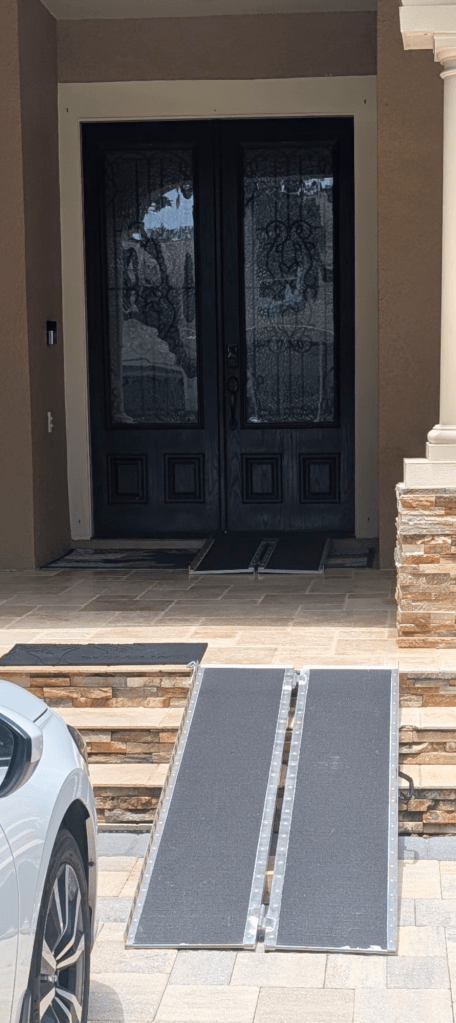
I walked across to my garage and brought back the two ramps for Sherri. Within minutes, we had them secured to their front steps. Just like that, they had a safer way for him to get in and out of his home.
It made me think.
It took us nearly a year to realize how much we truly needed those ramps. When you’re caring for someone with an incurable illness, watching them slowly lose their mobility, your mind is consumed by the next appointment, the next medication, the next crisis. Something as seemingly simple as installing a ramp somehow becomes another impossible decision. Which ramp? What angle? How do you secure it? Will it be safe? None of it feels simple when you’re living under constant pressure.
Yesterday, those hard-earned lessons allowed me to help someone else before it was too late. My neighbor gets to use the ramps while he can still walk with assistance, preserving a little more independence and, hopefully, preventing another fall.
I know Sherri loved this.
Even though she’s no longer here, her kindness continues to reach people she’ll never meet. Those ramps once carried her safely home. Now they’re helping a veteran like her father do the same.
Maybe that’s one of the quiet gifts of love. It doesn’t end when a life ends. It simply finds another person who needs it.
Yesterday wasn’t just about a couple of aluminum ramps.
It was another reminder that Sherri is still making the world a little better—through the people she changed, the lessons she taught, and the love she left behind.
Is This What Healing Feels Like?
Lately, I’ve been asking myself questions that don’t seem to have answers for.
Does everything eventually become routine?
Does everything that is new eventually become old?
They call it the “daily grind” for a reason, don’t they?
When does something lose its luster?
And perhaps the harder question…when do we?
The past year has changed me in ways I never expected. Losing my wife after watching her fight with every ounce of strength she had, trying to raise my daughter, helping fellow veterans navigate a system that often overwhelms them, trying to build a business with purpose—it has all been meaningful. Yet, at times, it has also been exhausting.
People sometimes tell me how strong I am.
The truth is, strength isn’t the absence of questions. Sometimes it’s simply continuing to put one foot in front of the other while carrying them.
Why do I struggle to feel purpose on some days when I know my work changes lives?
Why does my soul sometimes feel quiet instead of alive?
It isn’t that I lack free will. Every day I choose to move forward.
It isn’t that I cannot love. If anything, loving deeply has become both my greatest gift and my greatest source of pain.
So what is it?
Is my tank full—but filled with sand instead of water? Have years of responsibility, military service, loss, caregiving, and simply surviving filled every available space until joy has difficulty finding room?
Or is it something simpler? Is my brain still healing from grief? Are the chemicals that shape emotion simply trying to find their balance again?
I honestly don’t know.
What I do know is this: purpose doesn’t seem to be something we find once and keep forever. It fades. It changes. It asks us to search for it again and again.
When I help a veteran receive benefits they earned decades ago, I see purpose.
When I teach someone how to navigate the VA system so they can eventually do it themselves, I see purpose.
When my daughter smiles, I see purpose.
But even purpose doesn’t erase grief. It simply gives grief somewhere meaningful to stand.
Maybe that is what healing really is.
Not waking up one morning and feeling whole again.
Not forgetting the people we’ve lost.
Not pretending life is the same.
Maybe healing is learning that even when life loses some of its shine, it still has value. That even when our soul feels quiet, it is still there. That even when we don’t have all the answers, we can still choose kindness, service, and love.
I don’t know if everything eventually becomes ordinary.
I do know that the people we help, the lives we touch, and the love we give never truly lose their value.
Perhaps that’s enough for today.
Tomorrow, I’ll ask the questions again.
And I’ll keep walking anyway.

Learning from Mistakes: A DUI Reflection
For over 40 years, I have been behind the wheel, driving without incident—until now. I got a DUI. It still feels surreal to write those words. But the reality is, it happened, and I have no excuse. I have asked myself over and over, why did I not realize how dangerous and serious this was? And if I did, why did I not care?
Maybe it’s the weight of family burdens. Maybe it’s the inescapable reality of watching someone you love battle cancer—the most fatal form of it—a cruel, relentless adversary. Maybe it’s the anger and pain of an adolescent facing the potential loss of her mother. Maybe it’s depression, anxiety, or the gnawing exhaustion that comes with carrying so much.
The truth is, sometimes I feel like giving up on being the best version of myself. And I hate that feeling. But when it comes, it consumes me until something shakes me awake. This time, it was my DUI.
For years, I pushed the envelope. Since before I was 19, I thought I had control. How I managed to avoid hurting myself or someone else all these years is nothing short of a miracle. I could lie to myself and say, I never drove under the influence before—that I felt fine driving home that night. But that’s just not true.
I know chemistry. I understand biology. I know how alcohol affects the body, how it impairs judgment, and how much is too much. Yet, on that night, I just didn’t care. That’s the scariest part.
I passed the field sobriety test, but that didn’t matter. As I sat handcuffed in the back of the sheriff’s patrol car, all I could think was, It’s about time. I was taken to the DUI intake center and given a breathalyzer test—.10% BAC, 2% over the legal limit. From there, I was booked into the county jail and spent several hours waiting to post bail.
What came next was worse than my own shame. Scammers took advantage of the situation, calling my family including my children and friends, pretending to be a bail bonds company. My wife, out of concern, sent them $1,000 through Apple Pay. That loss, that embarrassment, was the worst part of the whole ordeal.
I am an Eagle Scout. An Army officer. I have built my life on helping others. And yet, I let this happen. It’s a humbling and haunting realization. But the response from my loved ones has been my saving grace. They did not ridicule me. They did not abandon me. Instead, they supported me, reminding me that one mistake—however significant—does not erase a lifetime of integrity and service.
This DUI is my wake-up call, my ghost of Christmas future, showing me what could be if I don’t change. It has forced me to confront my own choices, my vulnerabilities, and my need to truly take care of myself so I can continue taking care of others. I will take this harbinger seriously. I will strive to be better.
For those who may find themselves in a similar position, my message is simple: take responsibility, learn from it, and don’t ignore the signs. You don’t want to wait for your own wake-up call. Be better now.


