Blog Archives
Is This What Healing Feels Like?
Lately, I’ve been asking myself questions that don’t seem to have answers for.
Does everything eventually become routine?
Does everything that is new eventually become old?
They call it the “daily grind” for a reason, don’t they?
When does something lose its luster?
And perhaps the harder question…when do we?
The past year has changed me in ways I never expected. Losing my wife after watching her fight with every ounce of strength she had, trying to raise my daughter, helping fellow veterans navigate a system that often overwhelms them, trying to build a business with purpose—it has all been meaningful. Yet, at times, it has also been exhausting.
People sometimes tell me how strong I am.
The truth is, strength isn’t the absence of questions. Sometimes it’s simply continuing to put one foot in front of the other while carrying them.
Why do I struggle to feel purpose on some days when I know my work changes lives?
Why does my soul sometimes feel quiet instead of alive?
It isn’t that I lack free will. Every day I choose to move forward.
It isn’t that I cannot love. If anything, loving deeply has become both my greatest gift and my greatest source of pain.
So what is it?
Is my tank full—but filled with sand instead of water? Have years of responsibility, military service, loss, caregiving, and simply surviving filled every available space until joy has difficulty finding room?
Or is it something simpler? Is my brain still healing from grief? Are the chemicals that shape emotion simply trying to find their balance again?
I honestly don’t know.
What I do know is this: purpose doesn’t seem to be something we find once and keep forever. It fades. It changes. It asks us to search for it again and again.
When I help a veteran receive benefits they earned decades ago, I see purpose.
When I teach someone how to navigate the VA system so they can eventually do it themselves, I see purpose.
When my daughter smiles, I see purpose.
But even purpose doesn’t erase grief. It simply gives grief somewhere meaningful to stand.
Maybe that is what healing really is.
Not waking up one morning and feeling whole again.
Not forgetting the people we’ve lost.
Not pretending life is the same.
Maybe healing is learning that even when life loses some of its shine, it still has value. That even when our soul feels quiet, it is still there. That even when we don’t have all the answers, we can still choose kindness, service, and love.
I don’t know if everything eventually becomes ordinary.
I do know that the people we help, the lives we touch, and the love we give never truly lose their value.
Perhaps that’s enough for today.
Tomorrow, I’ll ask the questions again.
And I’ll keep walking anyway.

Serendipity
There are moments in life that feel accidental at first glance, but later settle into your heart as something much deeper. Moments where friendship, love, timing, grief, and grace all quietly intersect in a way that cannot simply be explained away as coincidence.
This past week, I took my first trip in four years without the overwhelming dread or guilt of leaving my wife behind. That alone felt strange to me. For years, every decision, every outing, every mile traveled carried the weight of caregiving and concern. Even moments that should have been joyful often carried an undercurrent of worry.
But this trip was different.
I traveled to Charleston to attend the graduation of the son of one of my classmates from our alma mater. It was a wonderful celebration filled with memories, laughter, and the strange realization that time continues to move forward whether we are ready for it or not. I stayed with another longtime classmate who still works at the school, and for a few days, I was surrounded by nearly forty years of friendship and shared history.
The morning after the celebration, I woke early and sat having coffee with my friend’s wife, someone I have also known for nearly four decades. We spoke quietly in that way people do in the early morning, before the world fully wakes up.
She shared how they had recently moved her parents from Maine to live near them in an independent living facility. Her father suffers from Alzheimer’s, and her mother from dementia. We talked about the difficult reality families face when navigating those diseases.
One of the strange truths about Alzheimer’s is that, as horrible as it is, there is often a somewhat defined progression. Dementia, however, can be incredibly broad and unpredictable. Symptoms vary wildly. Behaviors change suddenly. Good days and difficult days arrive without warning. For families who have never walked through it before, it can be exhausting, confusing, heartbreaking, and frustrating all at once.
Even after only a couple of months, I could already see the emotional toll it was taking on her.
She explained how her mother had insisted on hip surgery because she believed it would improve her quality of life, but instead, it had left her nearly immobile.
And immediately, my mind went to Sherri’s scooter.
For months, it had been sitting quietly in Sherri’s office gathering dust. A bright pink mobility scooter that no one else could ever possibly mistake for their own.
Of course it was pink.
Sherri insisted on pink.
Not just any pink scooter either. I had to drive more than one hundred miles to find one because she refused to settle for anything less than the exact shade she wanted to match her love of Lilly Pulitzer colors and style. Then she decorated it herself. She made a Lilly Pulitzer-style cover for the back seat, and because she was so tiny, we even added a piece of pink foam so her feet could comfortably reach the pedal.
That scooter was unmistakably hers.
As my friend’s wife spoke, I realized that the scooter sitting unused in Orlando could suddenly become something meaningful again.
I told her, “I have something that can help.”
It is amazing how easy it is nowadays to move something across the country. There truly is an app for everything. Within a short period of time, I found a kind gentleman willing to transport the scooter from Orlando to Charleston the very next day.
And just like that, Sherri’s little pink scooter was headed north to help another family carrying a burden of love and caregiving.
I sat there afterward thinking about how strange and beautiful life can sometimes be.
What are the odds that I would finally take my first trip away?
What are the odds that this conversation would happen over early morning coffee?
What are the odds that a scooter sitting unused for months would suddenly become exactly what another family needed?
Some people call that coincidence.
I do not.
I believe there are moments of divine intervention woven quietly into our lives. Moments where love continues moving long after someone is gone. Moments where friendship creates opportunities for compassion. Moments where grief transforms into purpose.
Serendipity is a funny thing. It often arrives carrying both sorrow and joy at the same time.
What touched me most was realizing that even now, Sherri is still helping people.
Even now, her kindness, personality, style, stubbornness, humor, and love are still moving through the world in tangible ways. A pink scooter decorated by her own hands is now going to reduce the burden on another daughter caring for her parents.
And honestly, I think that would make Sherri smile.
Life can be unbelievably difficult. Illness, loss, aging, caregiving, and grief all remind us how fragile we really are. But friendship, love, and compassion remind us that none of us were ever meant to carry those burdens alone.
Sometimes the greatest acts of grace are not the massive miracles.
Sometimes they are simply a cup of coffee, an old friendship, a heartfelt conversation, and a pink scooter finding its next purpose exactly when it is needed most.

What is planted in love is rarely lost.
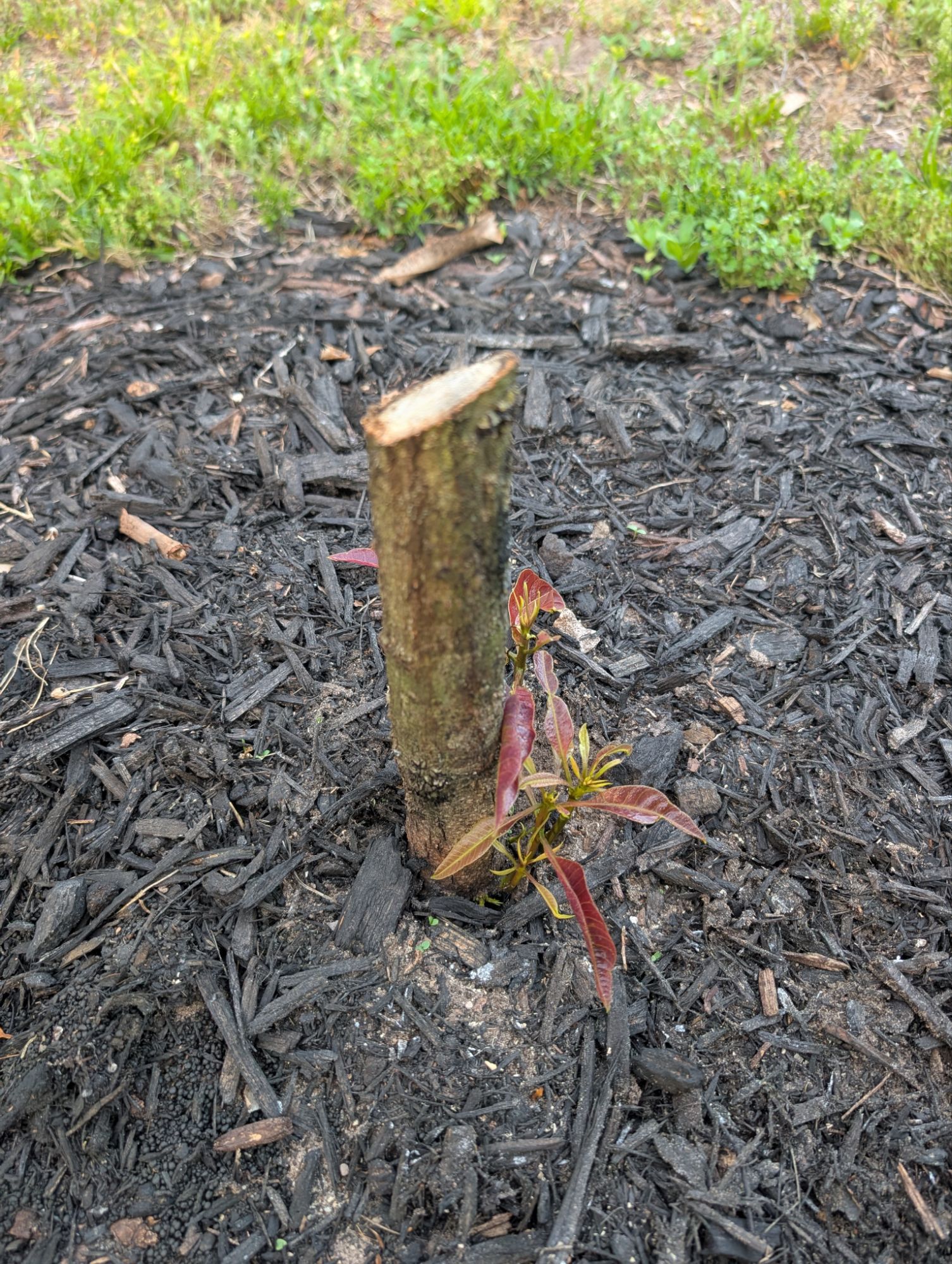
After the freeze, I posted a question on “Nextdoor” about our Kent Mango trees. I asked; are they beyond saving? They were so badly burned in the bitter frost even though I covered them and wet them. A gentlemen posted a response to cut them to the stump and they might grow back.
I hesitated for a month or two. I first cut the leaves, then the branches, then finally all the way to the stump. It’s been a month or two now, maybe even three.
I have lost track of time since Sherri has passed. I had given up on the two little Kent Mango trees. Her favorite variety. It took me months to find them for her.
Lo and behold, they’ve come back.
Sherri’s gone now.
I planted these trees for her. She did get to see them and they did even bloom once, but the frost killed them. But did it really? Like Sherri, they’re still here..
Like Sherri, everything she touched, is still here, still growing, still shining.
Her physical presence was touched by something so cruel and final, and yet what she planted in this world—through love, service, grace, banana bread, courage, family, and the way she made people feel seen—did not die with the frost. It remained in the roots of everyone she loved.
It will always be.
Understanding Anticipatory Grief as a Caregiver
I’ve spent a lifetime wearing uniforms — first in the military, then in business — but no uniform could have prepared me for the one I wear now: caregiver.
My wife is still here. She still smiles. Still laughs. Still says “I love you” with the same strength that got her through childbirth without a scream and once drove a screwdriver bit through her hand with nothing more than a calm “ouch.” But even with all that strength, I know what’s coming. And somewhere along the way, I realized I was already grieving.
It wasn’t denial that kept me from seeing it; I saw every scan, every new medication, every tear. It wasn’t anger that overwhelmed me, though I’ve certainly felt flashes of frustration — at broken systems, unanswered prayers, and my own helplessness. It was something quieter. Slower. A gradual ache of knowing that the woman I love is slipping away in pieces.
That’s what anticipatory grief is — mourning someone while they’re still alive. It’s showing up with love and purpose even as the shadows grow longer. It’s grieving not just the final goodbye, but the thousands of little ones along the way: the goodbye to traveling together, to her independence, to her baking and cooking in the kitchen.
I’ve come to understand that the five stages of grief — denial, anger, bargaining, depression, acceptance — aren’t a straight road. They’re more like a roundabout we circle again and again. And while Kübler-Ross introduced them to describe how patients face terminal illness, caregivers like me feel them too — just in advance.
Right now, I live somewhere between acceptance and heartbreak. I’ve accepted what’s coming. But each day, I still fight to create joy, dignity, and presence. We watch movies in the car so she doesn’t have to get out. We eat takeout in the bed because she cant sit at the table. I hold her hand not just in sickness, but in the holy weight of being here — now.
If you’re walking this road too, know that grief doesn’t wait for death. And love doesn’t wait for perfection. You are doing holy work, even when your hands feel empty.
Let yourself grieve. But also — let yourself love, fiercely, while there’s still time.