Blog Archives

Why VA Claim Mentor?
I spent over 20 years serving in the Army, but understanding my own VA disability claim was another journey altogether.
I filed my initial claim when I left the military in 2011. Then I waited 13 years to revisit it. A big part of that delay was guilt. Like many veterans, I thought I should just keep moving forward and manage what I was dealing with.
A retired Command Sergeant Major helped change that. While I was outside the room, emotionally overwhelmed, my wife, Sherri, told him about my conditions and how they affected my life. His encouragement helped me move forward. In 2024, I filed a supplemental claim, and my rating increased from 90% to 100%.
That experience became part of the foundation for VA Claim Mentor.
As I helped other veterans understand the process, I kept hearing the same questions: Where do I start? What records do I need? How do I explain what happened during my service and how it affects me today?
I took those conversations, my own experience, and the lessons learned through one-on-one mentorship and built a self-paced course. Bringing it to launch meant turning that knowledge into practical lessons and worksheets veterans could use at their own speed.
VA Claim Mentor is for veterans who want to prepare their own claim and understand what they are submitting. It provides education, not representation, and is not affiliated with the VA or federal government. It cannot promise a rating. It can teach you the process and how to advocate for yourself probably the most important part of this journey.
My goal is simple: help veterans file because they deserve it.
Making life easier—one veteran at a time.
Learn more at VA Claim Mentor

Yesterday was a great day.
After working with a gentleman for about six months—almost exactly the amount of time since my wife passed—we received notification that the VA had granted him a 60% disability rating.
For him, this was a giant win.
He served two tours in the Marine Corps and is a Desert Shield/Desert Storm veteran. One period of his service unfortunately ended with a bad conduct discharge after some things happened while he was young and going through a divorce. But he also had an honorable period of service, and that mattered.
He had tried three times before to receive VA disability compensation. He had worked with VSOs, but from what I could see, nobody had really looked deeply enough at his entire military history or separated the different periods of his service to determine what conditions could legitimately be connected to his honorable service.
He was referred to me by a retired Navy captain who had known him since they were Junior ROTC kids. Now, decades later, this Marine had served his country, lived with the consequences of that service, battled cancer and other medical problems, and still had never received the benefits he had earned.
So we went to work.
I used the same process I use with everyone: slow down, build the timeline, look at where they served, what they did, what happened to them, what they were exposed to, and what conditions followed them home. Then claim what the evidence supports.
Yesterday, he got his answer: 60%.
That means meaningful tax-free monthly compensation and access to additional VA benefits that can make a real difference in his life.
And I have to tell you, this one felt particularly good.
The last six months have also been some of the hardest months of my own life. I am learning how to live after losing my wife. I don’t think you ever really “recover” from something like that. You learn how to carry it. You find reasons to get up, reasons to keep moving, and hopefully reasons to continue being useful to somebody else.
Yesterday was one of those reasons.
Helping this Marine finally receive recognition for conditions connected to his service reminded me why I continue doing this work.
I hope someone reading this who has been putting off filing a VA disability claim—or who filed before and gave up—will reconsider.
I often describe VA disability compensation simply as workers’ compensation for service members. If military service injured you, made you sick, or caused a condition that continues affecting you today, there is no shame in asking the government to honor that obligation.
You don’t have to exaggerate anything.
You don’t have to claim something that isn’t true.
You just have to do the work, document your story, and advocate for yourself.
Sometimes you may need someone beside you to help you do it.
Yesterday reminded me how thankful I am that, at this point in my own life, I get to be that person for somebody else.
The Torch Has Been Passed
I did not think this day could come. Even after my son raised his right hand, a part of me never truly believed I would one day watch him become an active duty service member.
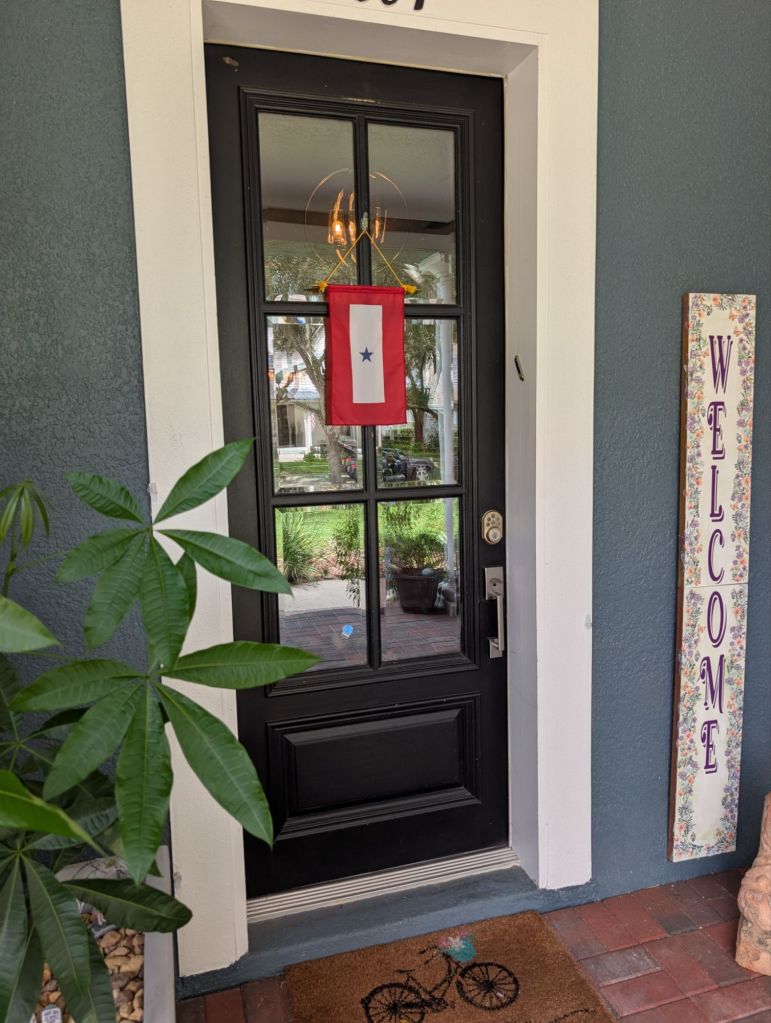
I recently hung a Blue Star Service Flag in my window. It is a daily reminder that the next generation continues to answer our nation’s call, accepting personal risk for a higher calling.
As a young boy, I knew I was meant to serve. Throughout my Army career, I rarely thought about the danger. The mission always came first. It wasn’t until I was saying goodbye to my own children before deployments that I began to understand where the real burden was carried.
Today, I see that burden through different eyes.
I used to reassure my family by saying it was more dangerous driving to the base in Atlanta than serving in the area of operations or on a forward operating base. At the time, I believed it. It was easy to say because I was the one going.
It is different when it is your son.
Modern warfare is different with these drones. But Information is still limited, uncertainty is constant, and the waiting can be relentless. Yet one truth has never changed: the hardest part of military service is often carried by the families who remain behind.
I have always been proud to serve my country.
Today, I am equally proud—and humbled—to be the father of someone who has chosen to do the same.
The torch has been passed. My prayers now travel with him, his wife, and every family waiting faithfully at home.
Is This What Healing Feels Like?
Lately, I’ve been asking myself questions that don’t seem to have answers for.
Does everything eventually become routine?
Does everything that is new eventually become old?
They call it the “daily grind” for a reason, don’t they?
When does something lose its luster?
And perhaps the harder question…when do we?
The past year has changed me in ways I never expected. Losing my wife after watching her fight with every ounce of strength she had, trying to raise my daughter, helping fellow veterans navigate a system that often overwhelms them, trying to build a business with purpose—it has all been meaningful. Yet, at times, it has also been exhausting.
People sometimes tell me how strong I am.
The truth is, strength isn’t the absence of questions. Sometimes it’s simply continuing to put one foot in front of the other while carrying them.
Why do I struggle to feel purpose on some days when I know my work changes lives?
Why does my soul sometimes feel quiet instead of alive?
It isn’t that I lack free will. Every day I choose to move forward.
It isn’t that I cannot love. If anything, loving deeply has become both my greatest gift and my greatest source of pain.
So what is it?
Is my tank full—but filled with sand instead of water? Have years of responsibility, military service, loss, caregiving, and simply surviving filled every available space until joy has difficulty finding room?
Or is it something simpler? Is my brain still healing from grief? Are the chemicals that shape emotion simply trying to find their balance again?
I honestly don’t know.
What I do know is this: purpose doesn’t seem to be something we find once and keep forever. It fades. It changes. It asks us to search for it again and again.
When I help a veteran receive benefits they earned decades ago, I see purpose.
When I teach someone how to navigate the VA system so they can eventually do it themselves, I see purpose.
When my daughter smiles, I see purpose.
But even purpose doesn’t erase grief. It simply gives grief somewhere meaningful to stand.
Maybe that is what healing really is.
Not waking up one morning and feeling whole again.
Not forgetting the people we’ve lost.
Not pretending life is the same.
Maybe healing is learning that even when life loses some of its shine, it still has value. That even when our soul feels quiet, it is still there. That even when we don’t have all the answers, we can still choose kindness, service, and love.
I don’t know if everything eventually becomes ordinary.
I do know that the people we help, the lives we touch, and the love we give never truly lose their value.
Perhaps that’s enough for today.
Tomorrow, I’ll ask the questions again.
And I’ll keep walking anyway.

Serendipity
There are moments in life that feel accidental at first glance, but later settle into your heart as something much deeper. Moments where friendship, love, timing, grief, and grace all quietly intersect in a way that cannot simply be explained away as coincidence.
This past week, I took my first trip in four years without the overwhelming dread or guilt of leaving my wife behind. That alone felt strange to me. For years, every decision, every outing, every mile traveled carried the weight of caregiving and concern. Even moments that should have been joyful often carried an undercurrent of worry.
But this trip was different.
I traveled to Charleston to attend the graduation of the son of one of my classmates from our alma mater. It was a wonderful celebration filled with memories, laughter, and the strange realization that time continues to move forward whether we are ready for it or not. I stayed with another longtime classmate who still works at the school, and for a few days, I was surrounded by nearly forty years of friendship and shared history.
The morning after the celebration, I woke early and sat having coffee with my friend’s wife, someone I have also known for nearly four decades. We spoke quietly in that way people do in the early morning, before the world fully wakes up.
She shared how they had recently moved her parents from Maine to live near them in an independent living facility. Her father suffers from Alzheimer’s, and her mother from dementia. We talked about the difficult reality families face when navigating those diseases.
One of the strange truths about Alzheimer’s is that, as horrible as it is, there is often a somewhat defined progression. Dementia, however, can be incredibly broad and unpredictable. Symptoms vary wildly. Behaviors change suddenly. Good days and difficult days arrive without warning. For families who have never walked through it before, it can be exhausting, confusing, heartbreaking, and frustrating all at once.
Even after only a couple of months, I could already see the emotional toll it was taking on her.
She explained how her mother had insisted on hip surgery because she believed it would improve her quality of life, but instead, it had left her nearly immobile.
And immediately, my mind went to Sherri’s scooter.
For months, it had been sitting quietly in Sherri’s office gathering dust. A bright pink mobility scooter that no one else could ever possibly mistake for their own.
Of course it was pink.
Sherri insisted on pink.
Not just any pink scooter either. I had to drive more than one hundred miles to find one because she refused to settle for anything less than the exact shade she wanted to match her love of Lilly Pulitzer colors and style. Then she decorated it herself. She made a Lilly Pulitzer-style cover for the back seat, and because she was so tiny, we even added a piece of pink foam so her feet could comfortably reach the pedal.
That scooter was unmistakably hers.
As my friend’s wife spoke, I realized that the scooter sitting unused in Orlando could suddenly become something meaningful again.
I told her, “I have something that can help.”
It is amazing how easy it is nowadays to move something across the country. There truly is an app for everything. Within a short period of time, I found a kind gentleman willing to transport the scooter from Orlando to Charleston the very next day.
And just like that, Sherri’s little pink scooter was headed north to help another family carrying a burden of love and caregiving.
I sat there afterward thinking about how strange and beautiful life can sometimes be.
What are the odds that I would finally take my first trip away?
What are the odds that this conversation would happen over early morning coffee?
What are the odds that a scooter sitting unused for months would suddenly become exactly what another family needed?
Some people call that coincidence.
I do not.
I believe there are moments of divine intervention woven quietly into our lives. Moments where love continues moving long after someone is gone. Moments where friendship creates opportunities for compassion. Moments where grief transforms into purpose.
Serendipity is a funny thing. It often arrives carrying both sorrow and joy at the same time.
What touched me most was realizing that even now, Sherri is still helping people.
Even now, her kindness, personality, style, stubbornness, humor, and love are still moving through the world in tangible ways. A pink scooter decorated by her own hands is now going to reduce the burden on another daughter caring for her parents.
And honestly, I think that would make Sherri smile.
Life can be unbelievably difficult. Illness, loss, aging, caregiving, and grief all remind us how fragile we really are. But friendship, love, and compassion remind us that none of us were ever meant to carry those burdens alone.
Sometimes the greatest acts of grace are not the massive miracles.
Sometimes they are simply a cup of coffee, an old friendship, a heartfelt conversation, and a pink scooter finding its next purpose exactly when it is needed most.

How AI Validates Personal Journeys and Emotions
When I first read the letter from Cleve.ai, I wasn’t entirely sure how to process it. It wasn’t a traditional award letter or recognition from a colleague, but rather a reflection generated by artificial intelligence. It summarized the essence of my efforts on LinkedIn throughout 2024—efforts I’ve often viewed as more personal musings than any calculated form of marketing or pontification. And yet, reading it stirred something deeply emotional and thought-provoking in me.
For much of my life, I’ve been under the impression that I came across as standoffish, maybe even arrogant. My efforts to communicate my values—faith, caregiving, selfless service—felt, at times, like shouting into the void. But here was this letter, written by an AI, mirroring back to me not the person I feared I might be, but the person I’ve strived to become: an empathic, kind soul who lifts others through action and advocacy.
The words resonated because they didn’t just state facts—they articulated the intentions behind my actions, the “why” of my life that I’ve always hoped to communicate but wasn’t sure anyone really heard. It was humbling and deeply moving to see my journey reflected in this way. For once, I felt truly understood, not just by the people around me, but perhaps even by myself.
This is the strange power of artificial intelligence: its ability to observe, synthesize, and reflect human emotion in ways we might not expect. To some, this might seem shallow or contrived—after all, how could a machine “know” anything about kindness or integrity? But for me, the experience highlighted something profound: AI, through its data and patterns, can sometimes help us see ourselves more clearly than we’re willing to on our own.
As I reflect on this, I realize that the power of the letter wasn’t just in what it said—it was in what it challenged me to believe. If an AI can see me as a beacon of hope and strength, why can’t I? If it can articulate my passion for caregiving, my unwavering faith, and my commitment to ethical service, why do I still hesitate to believe in those things myself?

The truth is, I’ve always used LinkedIn as a sounding board—not to market myself, but to give voice to the lessons, struggles, and triumphs of my journey. It’s as much for me as for anyone else who might be listening. This letter reminded me that, whether or not I always see it, those efforts matter. They create ripples, touch lives, and perhaps most importantly, reflect the values I hold most dear.
So, here I am, grappling with the strange and wonderful reality of emotions created by an artificial experience. It’s a reminder that sometimes, the mirrors we least expect—whether in the form of a friend, a stranger, or even an AI—can offer the clearest view of who we are.
And for that, I am grateful. Not just for the letter, but for the journey it reflects—and for the faith it inspires me to carry forward into 2025 and beyond.


