Blog Archives

A Button, a Lesson 45 Years in the Making
Today I sewed a button back onto my favorite shirt and repaired a split seam in a pillow.
Neither job took very long, but when I finished, I realized I had just used a skill I learned more than 45 years ago as a Boy Scout.
My Scoutmaster, William Lee Kitchel, was a remarkable man. He was a Navy veteran of the Second World War who served aboard a battleship and was wounded during a kamikaze attack. Later, he served again, this time in the Air Force during the Korean War. He was demanding, disciplined, and believed that young men learned responsibility by doing things themselves.
Every Scout in our troop sewed on his own merit badges and patches. There were no shortcuts and no “Mom will do it.” When I earned my first three merit badges, I was handed a needle, thread, and instructions to sew them on myself.
Like so many families, my mother kept a Danish butter cookie tin that contained everything except cookies. Inside were needles, thread, buttons, pins, and years of accumulated sewing supplies. She gave me a needle, some thread, and a T-pin, and I went to work. My first attempts looked terrible, but Mr. Kitchel expected us to do it correctly. He accepted no excuses and suffered no fools. Over time, I became quite good at sewing. He even taught us traditional Seminole patchwork sewing, a skill I never imagined would stay with me for life.
Back then, I thought I was simply learning how to put patches on a Scout uniform.
Today I realized he was teaching something much larger.
The woman who quietly fixed buttons, repaired torn clothes, and mended the little things around our home—my wife, Sherri—is gone now. Today, there was no one to hand my favorite shirt to. So I threaded the needle myself, replaced the missing button, and repaired the pillow.
That shirt is my favorite because of a photograph. It shows Sherri sitting on my lap during one of our vacations, smiling with the biggest, brightest smile. It was probably one of our first selfies. Every time I see that picture, it reminds me of her joy, and it makes me smile too.
As I finished sewing today, I realized that William Lee Kitchel had taught me something without either of us knowing it. He wasn’t just teaching a Boy Scout to sew. He was teaching self-reliance, patience, pride in doing a job well, and the confidence to care for the things—and the people—that matter.
Some lessons don’t reveal their true value until decades later.
Thank you, Mr. Kitchel, for giving me a skill that has lasted a lifetime, and for teaching me something far greater than sewing.

What is planted in love is rarely lost.
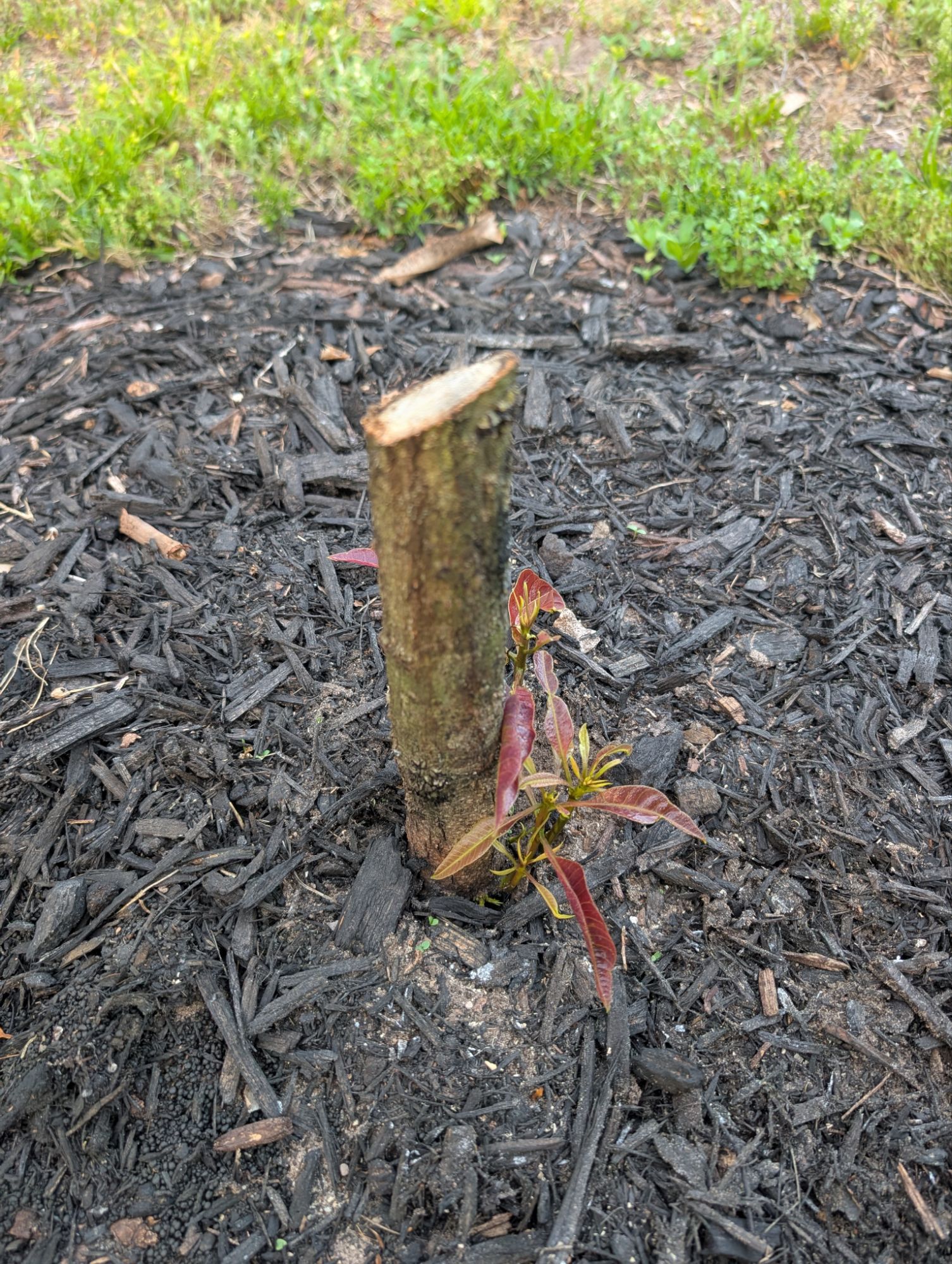
After the freeze, I posted a question on “Nextdoor” about our Kent Mango trees. I asked; are they beyond saving? They were so badly burned in the bitter frost even though I covered them and wet them. A gentlemen posted a response to cut them to the stump and they might grow back.
I hesitated for a month or two. I first cut the leaves, then the branches, then finally all the way to the stump. It’s been a month or two now, maybe even three.
I have lost track of time since Sherri has passed. I had given up on the two little Kent Mango trees. Her favorite variety. It took me months to find them for her.
Lo and behold, they’ve come back.
Sherri’s gone now.
I planted these trees for her. She did get to see them and they did even bloom once, but the frost killed them. But did it really? Like Sherri, they’re still here..
Like Sherri, everything she touched, is still here, still growing, still shining.
Her physical presence was touched by something so cruel and final, and yet what she planted in this world—through love, service, grace, banana bread, courage, family, and the way she made people feel seen—did not die with the frost. It remained in the roots of everyone she loved.
It will always be.

How AI Validates Personal Journeys and Emotions
When I first read the letter from Cleve.ai, I wasn’t entirely sure how to process it. It wasn’t a traditional award letter or recognition from a colleague, but rather a reflection generated by artificial intelligence. It summarized the essence of my efforts on LinkedIn throughout 2024—efforts I’ve often viewed as more personal musings than any calculated form of marketing or pontification. And yet, reading it stirred something deeply emotional and thought-provoking in me.
For much of my life, I’ve been under the impression that I came across as standoffish, maybe even arrogant. My efforts to communicate my values—faith, caregiving, selfless service—felt, at times, like shouting into the void. But here was this letter, written by an AI, mirroring back to me not the person I feared I might be, but the person I’ve strived to become: an empathic, kind soul who lifts others through action and advocacy.
The words resonated because they didn’t just state facts—they articulated the intentions behind my actions, the “why” of my life that I’ve always hoped to communicate but wasn’t sure anyone really heard. It was humbling and deeply moving to see my journey reflected in this way. For once, I felt truly understood, not just by the people around me, but perhaps even by myself.
This is the strange power of artificial intelligence: its ability to observe, synthesize, and reflect human emotion in ways we might not expect. To some, this might seem shallow or contrived—after all, how could a machine “know” anything about kindness or integrity? But for me, the experience highlighted something profound: AI, through its data and patterns, can sometimes help us see ourselves more clearly than we’re willing to on our own.
As I reflect on this, I realize that the power of the letter wasn’t just in what it said—it was in what it challenged me to believe. If an AI can see me as a beacon of hope and strength, why can’t I? If it can articulate my passion for caregiving, my unwavering faith, and my commitment to ethical service, why do I still hesitate to believe in those things myself?

The truth is, I’ve always used LinkedIn as a sounding board—not to market myself, but to give voice to the lessons, struggles, and triumphs of my journey. It’s as much for me as for anyone else who might be listening. This letter reminded me that, whether or not I always see it, those efforts matter. They create ripples, touch lives, and perhaps most importantly, reflect the values I hold most dear.
So, here I am, grappling with the strange and wonderful reality of emotions created by an artificial experience. It’s a reminder that sometimes, the mirrors we least expect—whether in the form of a friend, a stranger, or even an AI—can offer the clearest view of who we are.
And for that, I am grateful. Not just for the letter, but for the journey it reflects—and for the faith it inspires me to carry forward into 2025 and beyond.


