Blog Archives
Yesterday was a great day.
After working with a gentleman for about six months—almost exactly the amount of time since my wife passed—we received notification that the VA had granted him a 60% disability rating.
For him, this was a giant win.
He served two tours in the Marine Corps and is a Desert Shield/Desert Storm veteran. One period of his service unfortunately ended with a bad conduct discharge after some things happened while he was young and going through a divorce. But he also had an honorable period of service, and that mattered.
He had tried three times before to receive VA disability compensation. He had worked with VSOs, but from what I could see, nobody had really looked deeply enough at his entire military history or separated the different periods of his service to determine what conditions could legitimately be connected to his honorable service.
He was referred to me by a retired Navy captain who had known him since they were Junior ROTC kids. Now, decades later, this Marine had served his country, lived with the consequences of that service, battled cancer and other medical problems, and still had never received the benefits he had earned.
So we went to work.
I used the same process I use with everyone: slow down, build the timeline, look at where they served, what they did, what happened to them, what they were exposed to, and what conditions followed them home. Then claim what the evidence supports.
Yesterday, he got his answer: 60%.
That means meaningful tax-free monthly compensation and access to additional VA benefits that can make a real difference in his life.
And I have to tell you, this one felt particularly good.
The last six months have also been some of the hardest months of my own life. I am learning how to live after losing my wife. I don’t think you ever really “recover” from something like that. You learn how to carry it. You find reasons to get up, reasons to keep moving, and hopefully reasons to continue being useful to somebody else.
Yesterday was one of those reasons.
Helping this Marine finally receive recognition for conditions connected to his service reminded me why I continue doing this work.
I hope someone reading this who has been putting off filing a VA disability claim—or who filed before and gave up—will reconsider.
I often describe VA disability compensation simply as workers’ compensation for service members. If military service injured you, made you sick, or caused a condition that continues affecting you today, there is no shame in asking the government to honor that obligation.
You don’t have to exaggerate anything.
You don’t have to claim something that isn’t true.
You just have to do the work, document your story, and advocate for yourself.
Sometimes you may need someone beside you to help you do it.
Yesterday reminded me how thankful I am that, at this point in my own life, I get to be that person for somebody else.

When the Ramps Found Their Next Home
Yesterday was a good day.
My neighbor is a Vietnam veteran. Neuropathy has slowly been taking its toll on his legs and lower back, and lately he’s been falling more often. While talking with his daughter, who cares for him, she mentioned they wished they had a safer way to get down the front steps.
“Hold on a second,” I said.
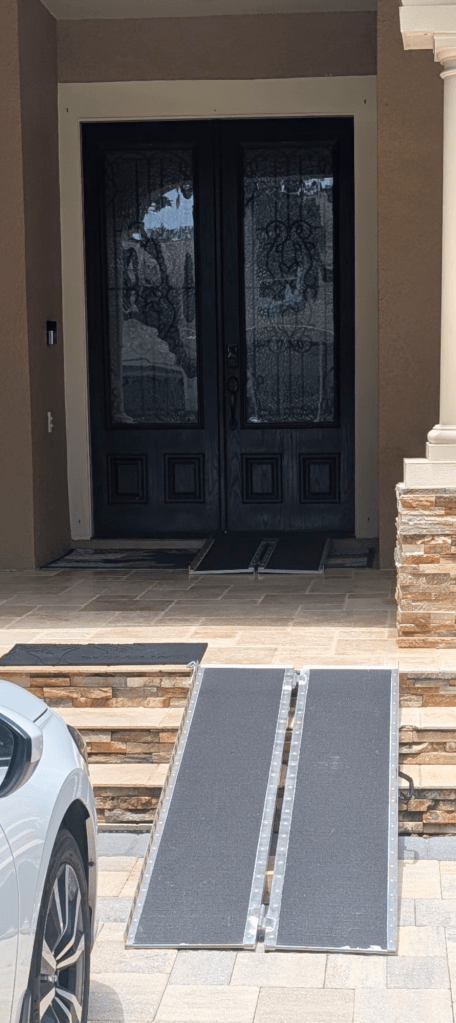
I walked across to my garage and brought back the two ramps for Sherri. Within minutes, we had them secured to their front steps. Just like that, they had a safer way for him to get in and out of his home.
It made me think.
It took us nearly a year to realize how much we truly needed those ramps. When you’re caring for someone with an incurable illness, watching them slowly lose their mobility, your mind is consumed by the next appointment, the next medication, the next crisis. Something as seemingly simple as installing a ramp somehow becomes another impossible decision. Which ramp? What angle? How do you secure it? Will it be safe? None of it feels simple when you’re living under constant pressure.
Yesterday, those hard-earned lessons allowed me to help someone else before it was too late. My neighbor gets to use the ramps while he can still walk with assistance, preserving a little more independence and, hopefully, preventing another fall.
I know Sherri loved this.
Even though she’s no longer here, her kindness continues to reach people she’ll never meet. Those ramps once carried her safely home. Now they’re helping a veteran like her father do the same.
Maybe that’s one of the quiet gifts of love. It doesn’t end when a life ends. It simply finds another person who needs it.
Yesterday wasn’t just about a couple of aluminum ramps.
It was another reminder that Sherri is still making the world a little better—through the people she changed, the lessons she taught, and the love she left behind.
The Power of Presence: How to Support Caregivers
When someone you love is gravely ill or bedridden, the world becomes very small. The walls of the home close in. Time slows. Days blur together. Both the person being cared for—and the caregiver—begin to live in a kind of suspended animation, where joy, spontaneity, and connection are replaced by routine, worry, and waiting.
People often ask, “What can I do?”
And it’s a sincere question. They want to help. So they send flowers. Cards. Food. Gift cards. And all of those are kind gestures. All of them are appreciated.
But if you really want to help a caregiver—and the person they’re caring for—be present. Show up.
Caregiving is not just physically exhausting. It’s emotionally isolating. The one who is ill is often trapped in their body, in their symptoms, in a bed they can’t escape. The caregiver, meanwhile, is trapped in responsibility, routine, and quiet desperation.
Isolation is the great thief.
It steals joy, perspective, and sometimes even hope. But when someone walks through the door just to be there, everything changes—even if only for a little while.
Here’s what you may not see:
When visitors come over, something shifts.
The house feels lighter.
The person being cared for suddenly wants to sit up straighter, to smile, to tell stories—even if they can’t move or speak much.
The caregiver may finally exhale, just a little.
You don’t need to bring anything. Just your presence. A shared moment. A hand held. A joke told. A prayer whispered.
It’s not about what you do. It’s about that you came.
We often overcomplicate compassion. We think we need the “right” thing, the perfect timing, or something polished and proper.
But love isn’t complicated.
Compassion shows up unannounced and says, “I’m here.”
It’s the ministry of presence.
So, if you’re wondering how to help:
- Visit. Even 15 minutes can be sacred.
- Sit. Watch a show, listen to music, share a memory.
- Talk. About something—anything—besides illness.
- Listen. Sometimes just being a witness to the struggle is a gift.
- Stay connected. Don’t let their world shrink without a fight.
Because at the end of the day, love looks like presence. And presence heals in ways medicine can’t.


Life Changes in an Instant: A Caregiver’s Journey
We’ve all heard the phrase: “In the blink of an eye, everything can change.” It’s easy to brush off—it’s a quote we’ve heard in books, seen in movies, or used when something minor goes sideways. I’ve heard it a million times. But living it—really living it—is different.
As a two-time caregiver, I’ve come to truly understand the depth of that phrase. This second time around has given me what we used to call in the military situational awareness. That’s the moment when you stop reacting emotionally and begin assessing reality: the inputs, the outputs, and what you can do—even if it’s just mitigating the damage.
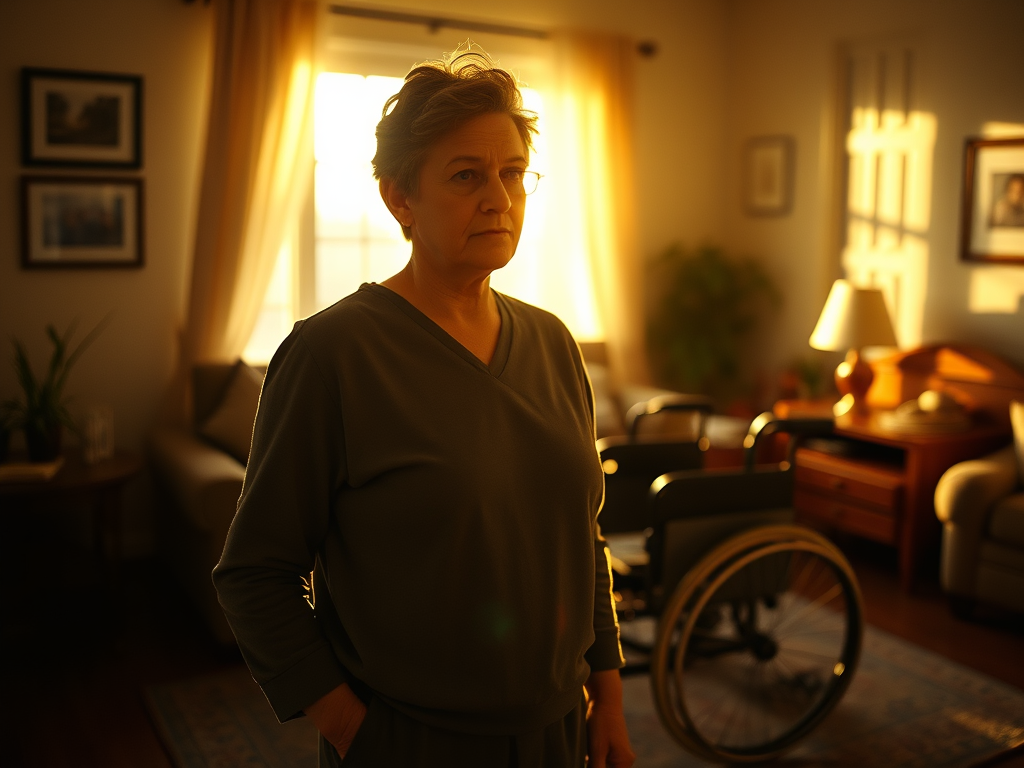
A few months ago, my wife hadn’t walked in six months. Chemo had ravaged her body. She was pale, fragile, eyes sunken. I’d seen that look before in others, but this was my wife.
Then one morning, I walked into our little home gym and found her wheelchair stuck in the doorway. I looked across the room and there she was, standing—cleaning out a closet.
“How did you get over there?” I asked, stunned.
“I walked,” she said.
Using the treadmill and bench to balance herself, she’d made her way across the room. That was the first time in half a year. I yelled for our son—his mom had walked. Within a week she was moving around the house. Within a month, she was logging 5,000 steps a day, laughing with friends, going to parties. Her oncologist called it miraculous.
Life returned. Our home was lighter. The walker and wheelchair went back in the garage. We stopped arguing. We were happy again—almost like the storm had passed without us noticing.
Then her knee started to ache. Badly. We pulled the walker back out. Then the wheelchair. And when I had to reinstall the ramp on our front steps… that’s when it hit me.
We were back at the bottom.
Tensions flared again. My daughter and I, already frayed, started arguing like before. Caregiving is constant—it never turns off. It demands your whole being. You feel like if you step away for even a moment, everything might fall apart.
But this time… I told myself it would be different.
My wife, thankfully, was approved for Social Security Disability in a single day. Say what you will about government programs—but after 40 years of paying taxes, that moment mattered. It gave us some breathing room. I no longer needed to work part time just to get by. Now, I could be present. For her. For our daughter. And for myself.
That meant waking early. Drinking my coffee in peace. Saying my mantras. Walking the dogs. Going to fitness class. Writing. Reflecting.
We were gifted three months of light. Three months of freedom. And even if that season never returns, I will always cherish it.
Because I know how quickly it can all change.
Situational awareness isn’t just for combat zones. It’s for living rooms. For hospital beds. For quiet corners where you cry alone. It’s knowing when to breathe, when to speak, and when to let go of trying to control what can’t be controlled.
It’s about grace.
It’s about gratitude.
And it’s about recognizing—in the blink of an eye—that even the smallest step forward is a miracle worth holding onto.