Blog Archives
Service Should Start Close to Home
I have been thinking a lot about what it means to give back without making it about yourself.
One of the things I have always admired about the ideals of our founding fathers is the belief that citizenship carries responsibility. You contribute. You serve. You try to leave your community a little better than you found it.
That is something I want reflected in my little company as well.
I am fortunate that the business has created some profit, and rather than simply talking about community, veterans, service, or helping others, I decided I wanted to actually do something with a portion of it.
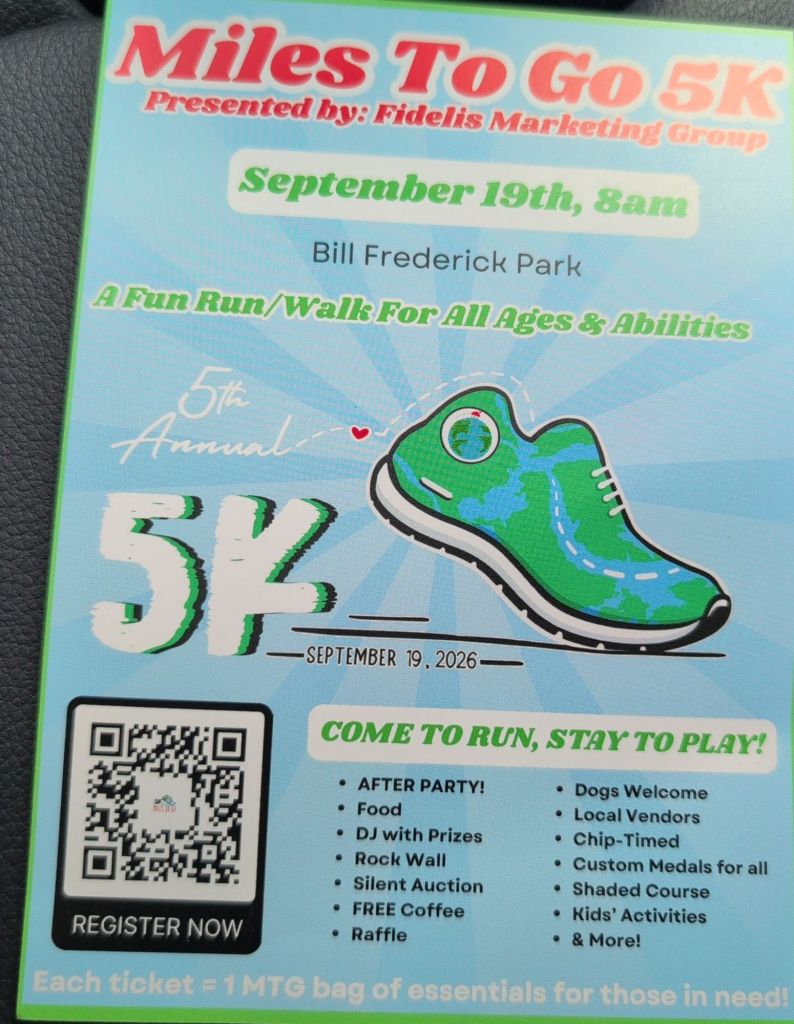
I selected a local nonprofit, Miles to Go, that helps people experiencing homelessness in the Orlando community. Homelessness is difficult enough under any circumstance, but homeless veterans in particular are something I have always cared about.
At the same time, health and fitness have long been an important part of my life. So when I saw an opportunity to support a 5K that benefits Miles to Go, it felt like a natural fit.
I anonymously paid for several people to participate.
I am not sharing that because I think it is some grand gesture. It is not. I am sharing it because I think businesses, even very small ones, have an opportunity to decide what they stand for through their actions.
We hear people say all the time that we should help veterans, support our communities, care for people in need, and improve our health. Those are good words. But somewhere along the way, the words have to become actions.
As the old saying goes, put your money where your mouth is.
For me, this is also about honoring the people and experiences that have shaped my life. It is about my late wife, my family, my military service, the people who have supported me, and the values I continue to hold dear.
Service does not always have to be large, public, or complicated.
Sometimes it is simply deciding that when you have a little extra, you share a little of it.
My company is small. Its contribution is small.
But if that contribution helps someone take another step forward, then it mattered.
And for me, that is enough.
When the Ramps Found Their Next Home
Yesterday was a good day.
My neighbor is a Vietnam veteran. Neuropathy has slowly been taking its toll on his legs and lower back, and lately he’s been falling more often. While talking with his daughter, who cares for him, she mentioned they wished they had a safer way to get down the front steps.
“Hold on a second,” I said.
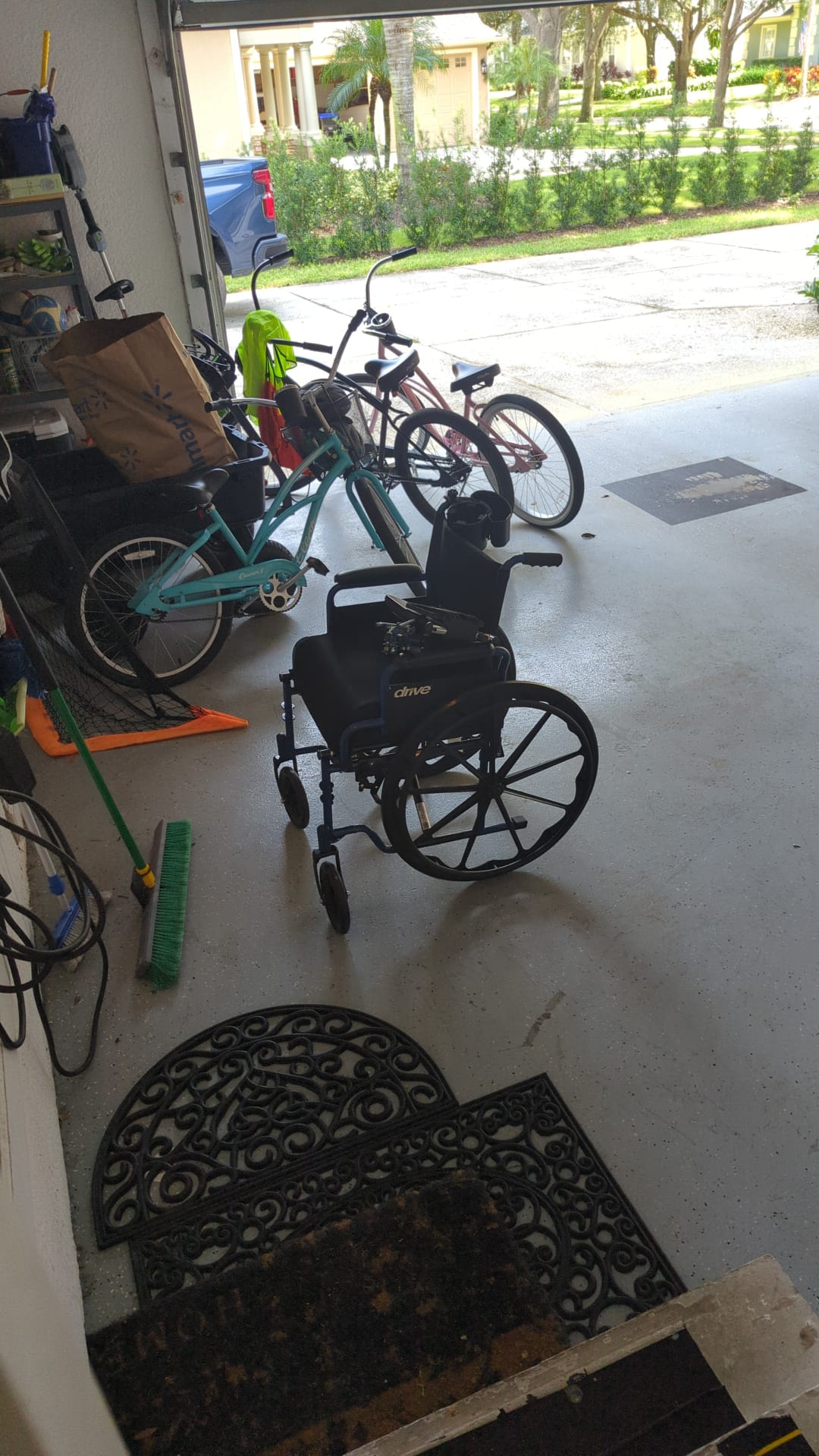
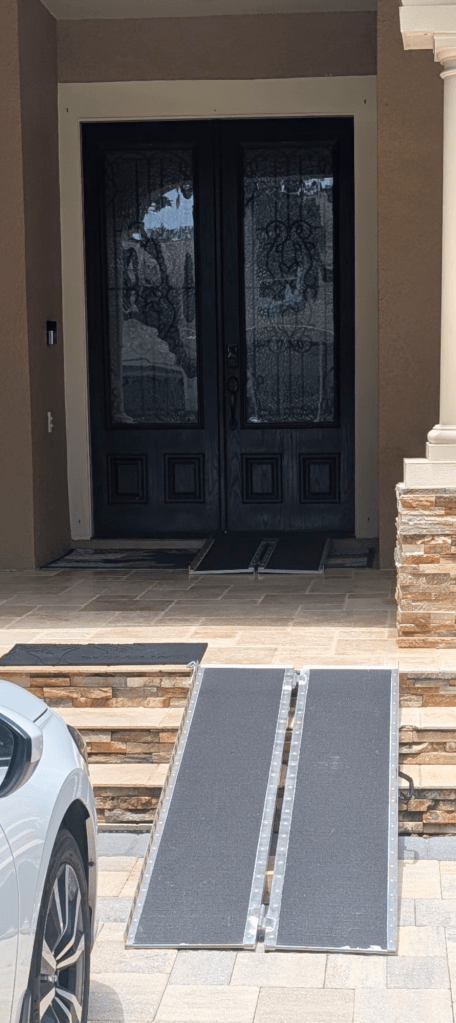
I walked across to my garage and brought back the two ramps for Sherri. Within minutes, we had them secured to their front steps. Just like that, they had a safer way for him to get in and out of his home.
It made me think.
It took us nearly a year to realize how much we truly needed those ramps. When you’re caring for someone with an incurable illness, watching them slowly lose their mobility, your mind is consumed by the next appointment, the next medication, the next crisis. Something as seemingly simple as installing a ramp somehow becomes another impossible decision. Which ramp? What angle? How do you secure it? Will it be safe? None of it feels simple when you’re living under constant pressure.
Yesterday, those hard-earned lessons allowed me to help someone else before it was too late. My neighbor gets to use the ramps while he can still walk with assistance, preserving a little more independence and, hopefully, preventing another fall.
I know Sherri loved this.
Even though she’s no longer here, her kindness continues to reach people she’ll never meet. Those ramps once carried her safely home. Now they’re helping a veteran like her father do the same.
Maybe that’s one of the quiet gifts of love. It doesn’t end when a life ends. It simply finds another person who needs it.
Yesterday wasn’t just about a couple of aluminum ramps.
It was another reminder that Sherri is still making the world a little better—through the people she changed, the lessons she taught, and the love she left behind.

A Button, a Lesson 45 Years in the Making
Today I sewed a button back onto my favorite shirt and repaired a split seam in a pillow.
Neither job took very long, but when I finished, I realized I had just used a skill I learned more than 45 years ago as a Boy Scout.
My Scoutmaster, William Lee Kitchel, was a remarkable man. He was a Navy veteran of the Second World War who served aboard a battleship and was wounded during a kamikaze attack. Later, he served again, this time in the Air Force during the Korean War. He was demanding, disciplined, and believed that young men learned responsibility by doing things themselves.
Every Scout in our troop sewed on his own merit badges and patches. There were no shortcuts and no “Mom will do it.” When I earned my first three merit badges, I was handed a needle, thread, and instructions to sew them on myself.
Like so many families, my mother kept a Danish butter cookie tin that contained everything except cookies. Inside were needles, thread, buttons, pins, and years of accumulated sewing supplies. She gave me a needle, some thread, and a T-pin, and I went to work. My first attempts looked terrible, but Mr. Kitchel expected us to do it correctly. He accepted no excuses and suffered no fools. Over time, I became quite good at sewing. He even taught us traditional Seminole patchwork sewing, a skill I never imagined would stay with me for life.
Back then, I thought I was simply learning how to put patches on a Scout uniform.
Today I realized he was teaching something much larger.
The woman who quietly fixed buttons, repaired torn clothes, and mended the little things around our home—my wife, Sherri—is gone now. Today, there was no one to hand my favorite shirt to. So I threaded the needle myself, replaced the missing button, and repaired the pillow.
That shirt is my favorite because of a photograph. It shows Sherri sitting on my lap during one of our vacations, smiling with the biggest, brightest smile. It was probably one of our first selfies. Every time I see that picture, it reminds me of her joy, and it makes me smile too.
As I finished sewing today, I realized that William Lee Kitchel had taught me something without either of us knowing it. He wasn’t just teaching a Boy Scout to sew. He was teaching self-reliance, patience, pride in doing a job well, and the confidence to care for the things—and the people—that matter.
Some lessons don’t reveal their true value until decades later.
Thank you, Mr. Kitchel, for giving me a skill that has lasted a lifetime, and for teaching me something far greater than sewing.
Divine Intervention in the Everyday: Lessons in Caregiving, Love, and Community
I never imagined I’d need to use a handicap space. When I received my 100% VA disability rating, I made a silent promise: I’d never park in those spaces. I felt strong and capable, able to walk to and from the store without issue. Florida even offers free license plates for veterans like me, allowing us to park closer to ease movement, but I couldn’t foresee a time when I wouldn’t be able to make it in and out of Publix on my own two feet.
But life has a way of humbling us and revealing new perspectives. I recently found myself borrowing a wheelchair from our neighbors for my wife. She is fighting cancer again, and chemotherapy has made her legs ache with a pain. She is much like my father—strong-willed and independent, reluctant to ask for help or accept it. It’s one of the things I love most about her, this tenacity and resolve to live life fully on her terms. Yet, there are moments when emotion trumps logic, and she insists on walking, only to end up soaking her aching joints in a bathtub at 3 a.m.
Today, as I wheeled her around, I saw things differently. For the first time, I saw the purpose of those license plates I had so casually dismissed before. In a way, I felt the hand of God gently guiding me to see a deeper truth—that we all need help, and we will all be caregivers at some point in our lives. Rosemary Carter and Elizabeth Dole taught me this lesson, but life has reinforced it repeatedly.
I remember my father’s journey. A proud man, old school in every way, he despised the thought of using a wheelchair. For two hard years, he resisted help as he made his journey home, never once wanting to appear weak or dependent. I see so much of him in my wife now. She, too, is not accustomed to accepting help, yet her strength lies not just in her independence but in the love and resilience she shows every day, even through gritted teeth and stubborn defiance.
Our neighbors, older friends who have always been there for us, offered their wheelchair without a second thought. It’s moments like this that remind me of the power of community, of being a good neighbor. We help each other, not because we have to, but because it is a reflection of love, of being there when needed, without question or hesitation.
Sometimes, the carefully curated Instagram smiles need to be set aside so we can face reality. Life is not always picture-perfect; it is messy, challenging, and often painful. But it is also filled with grace, with moments of divine intervention that remind us of our purpose and our place in the world.
Today, my license plate makes sense. I see God’s plan unfold in the most unexpected ways. I am here, not just as a veteran with a rating but as a husband, a caregiver, a neighbor, and a servant of love. My wife’s determination to live life fully, even when it means being a little grumpy about the wheelchair, is a testament to the spirit we all share—the spirit to keep moving forward, to love fiercely, and to serve selflessly.
So, I embrace this role, this chance to support her in her journey, however she demands it. And in doing so, I see that God is indeed at work, weaving all these threads—divine intervention, caregiving, love, selfless service, and community—into a beautiful tapestry that is my life.