The Missing Millions: Why So Many Veterans Still Lack Disability Ratings
In the United States today, a significant portion of the veteran population remains without a service-connected disability rating—even though many receive ongoing care from the Department of Veterans Affairs (VA). This gap affects millions and stems from long-standing structural issues and common misunderstandings.
How Many Veterans Are Unrated?
Recent federal data shows:
17.8 million veterans currently live in the U.S.
Only 5.2 million (about 30%) have a service-connected disability rating.
That leaves roughly 12.5 million veterans without a rating, including an estimated 6 million who separated before disability assessments became part of the mandatory out-processing process.
Before the mid-1990s and early 2000s reforms, the DoD did not require a disability evaluation as part of separation or retirement. Millions of veterans left service with no assessment and never filed later simply because the process was unclear or unknown.
Two VA Systems — and They Don’t Communicate
A critical fact many veterans do not know:
VA Healthcare and VA Disability Compensation are completely separate systems.
Receiving VA medical care does not create or update a disability rating.
Diagnoses, imaging, or treatment inside VA healthcare records are not reviewed for disability compensation unless a veteran files a claim.
No condition—primary or secondary—moves into the disability system automatically.
Many veterans assume that being treated for chronic pain, orthopedic injuries, sleep issues, or mental health conditions means their disability file is being updated. It isn’t. Only a formal claim triggers review.
The Impact on Veterans
Millions of veterans who never filed a claim at all.
Veterans with worsening conditions who never requested rating increases.
VA healthcare patients with serious diagnoses that were never evaluated for service-connection.
Missed compensation, lost benefits, and reduced access to programs tied to rating thresholds.
A single misconception—“VA healthcare updates my disability rating”—can cost a veteran years of deserved benefits.
What Every Veteran Should Do Now
To ensure disability benefits reflect current health conditions, veterans should:
1. Review their conditions regularly
Check for new diagnoses, worsening symptoms, or secondary conditions.
2. File new or supplemental claims
Use VA.gov, mail, or accredited submission channels to request evaluation.
3. Understand the system
VA healthcare records do not update disability ratings. A claim must be submitted.
4. Track secondary conditions
Issues like sleep apnea, depression, migraines, radiculopathy, GERD, or joint degeneration often stem from service-connected primaries.
Veterans who separated before mandatory disability evaluations around 2010 are especially vulnerable because many were never informed of the modern process.
Closing the Gap
With only ~30% of veterans holding a disability rating—and millions eligible but unrated—awareness is essential. Understanding that VA healthcare and VA disability compensation operate independently is the first step toward ensuring every veteran receives the benefits they earned through service.
Need Help Understanding Your Claim Path?
If you or a veteran you know is unsure about eligibility, secondary conditions, or how to properly file, guidance is available. Filing a claim is not automatic—but it can be straightforward when you understand the rules and requirements.


A Journey to Acceptance: My Eye-Opening Experience with Medical Marijuana
I was born and raised in Miami, Florida — in the middle of chaos and change. The city I grew up in during the 70s and 80s was a powder keg of race riots, refugees, and drugs. Miami was overrun — and that’s putting it kindly. Cocaine, marijuana, and the war on drugs were everywhere.
I never touched any of it. Not once.
It was a badge of honor, a personal vow. My father was a judge, and I took pride in the discipline that kept me away from substances that, to me, represented weakness and failure. I saw alcohol as adult, social, and controlled. Marijuana? That was for the lost.
For most of my life, I never questioned that belief.
But life has a way of testing the walls we build around our certainty.
When my wife’s illness began to take over our nights, sleep became hard. She was in constant pain, and nothing — not the pills, not the prescriptions, not the endless “next options” — brought her relief without a cost. Then one night, she tried a simple gummy. She slept through the night.
That experience made me aware — painfully so — of my own hypocrisy. While she found healing through a plant I had long dismissed, I was numbing myself each night with alcohol — not to enjoy, but to stop feeling, to force sleep. I told myself it was normal, acceptable, even earned. But it wasn’t helping.
It wasn’t until I was helping a client — a veteran — through her VA disability claim that the truth caught up with me. She confided in me about her fear of admitting she used marijuana to manage anxiety and sleep. I told her what I believed: that she shouldn’t be ashamed, that seeking help isn’t weakness, and that medical care, when legal and responsible, is private and protected.
Then it hit me like a mirror.
How could I coach her toward honesty and healing while denying myself the same?
That same day, I called my wife’s physician, scheduled an appointment, and applied for my medical marijuana card. Since then, I take a gummy every night. I sleep. I think more clearly. I drink less. I feel present.
My view has changed completely — not because of politics or persuasion, but because of experience. What I once called weakness, I now see as wisdom. The real weakness was refusing to see past my own judgment.
In Florida, medical marijuana has been lawful since 2016. But for me, it only became personal when life humbled me enough to listen.
The more I experience life, the more I understand that nothing truly changes until we become aware. Awareness brings empathy, and empathy brings wisdom. And wisdom — I’ve learned — is not the privilege of youth, but the product of life lived honestly.


How to Add Evidence to Your VA Disability Claim
I have been getting the title of the this alot.
Yes, you can add evidence to a VA disability claim after it has been submitted, as long as the claim is still open (not yet decided). Great example, is you decide to have a provider complete the VAs DBQ as your medical evidence is limited and it was after you already pressed submit. Some claims take several months so you shouldn’t worry about not submitting it.
Here are your options depending on the stage of your claim:
✅ If the claim is still in progress (Pending / Under Review):
You can submit additional evidence directly via:
- VA.gov (log in → go to your claim → “Upload documents”) Only method I recommend
- Mail to: Department of Veterans Affairs
Claims Intake Center
PO Box 4444
Janesville, WI 53547-4444
(Use a VA Form 21-4138 or 20-10210 to explain what you’re submitting) - Fax: 844-531-7818 (for domestic) or 248-524-4260 (international)
- Mail to: Department of Veterans Affairs
Be sure to include:
- Your VA file number or SSN
- The specific claim it relates to
- A clear description of what the evidence is and why it’s relevant
If a decision has already been made: (you got your claim letter back from the VA)
You cannot just “add” evidence—you’ll need to take one of these steps:
| Scenario | Action | Form |
|---|---|---|
| You’re still within the 1-year appeal window | File a Supplemental Claim | VA Form 20-0995. do it online and your lay letters don’t have to be on the official form |
| You think a clear error was made | File a Higher-Level Review | VA Form 20-0996 do it online and your lay letters don’t have to be on the official form |
| You want a hearing with a judge (last last resort) | File a Board Appeal (18 months!) | VA Form 10182 do it online and your lay letters don’t have to be on the official form |
In all three cases, you can submit new evidence (except during Higher-Level Review, where no new evidence is allowed).
Hope this helps folks out there!

What will my life be like in 3 years?
I dare not answer the question.
That was my first response when someone asked where I see myself in three years. Without hesitation, fear stepped in — not fear of failure, but fear of imagining life beyond now. Beyond her.
Yesterday, my wife finalized her cremation plans. I’ve done this before — for my sister, for my father. Each time, it became a necessary transaction. Paperwork, signatures, polite condolences exchanged over a table that felt too small for the weight in the room. The funeral director came to the house. We completed the forms. She paid for her services. Efficient. Respectful. Businesslike.
It’s best to do this before it happens, they say — so there’s one less thing to cause anxiety and pain.
But is that really true? Or is it that I just didn’t want to do this again?
Because the truth is, no matter how many times I’ve faced loss, I still don’t know how to prepare for it. I can manage logistics, but not emotions. I can sign the papers, but not the permission slip to move forward.
When I think about the future — traveling, my children, my new grandbaby — I feel guilty. There’s a horrible tension between the yearning to be free and the desperate wish for this stage of life to never end. How do you reconcile wanting relief and wanting permanence at the same time?
Maybe that’s what being human really is — living inside the contradiction.
We spend our lives trying to control time, plan for tomorrow, build systems, write goals. But life keeps reminding us it doesn’t belong to us. It moves with or without our consent.
Three years from now, I don’t know where I’ll be. Maybe I’ll be standing somewhere new, lighter but not the same. Maybe I’ll still wake up some mornings expecting to hear her voice. Maybe I’ll finally find a kind of peace in the not-knowing.
Because the truth is, none of us can control life. We can only honor it
Where will I be in 3 years…..

It Takes a Village: The Realities of End-of-Life Care
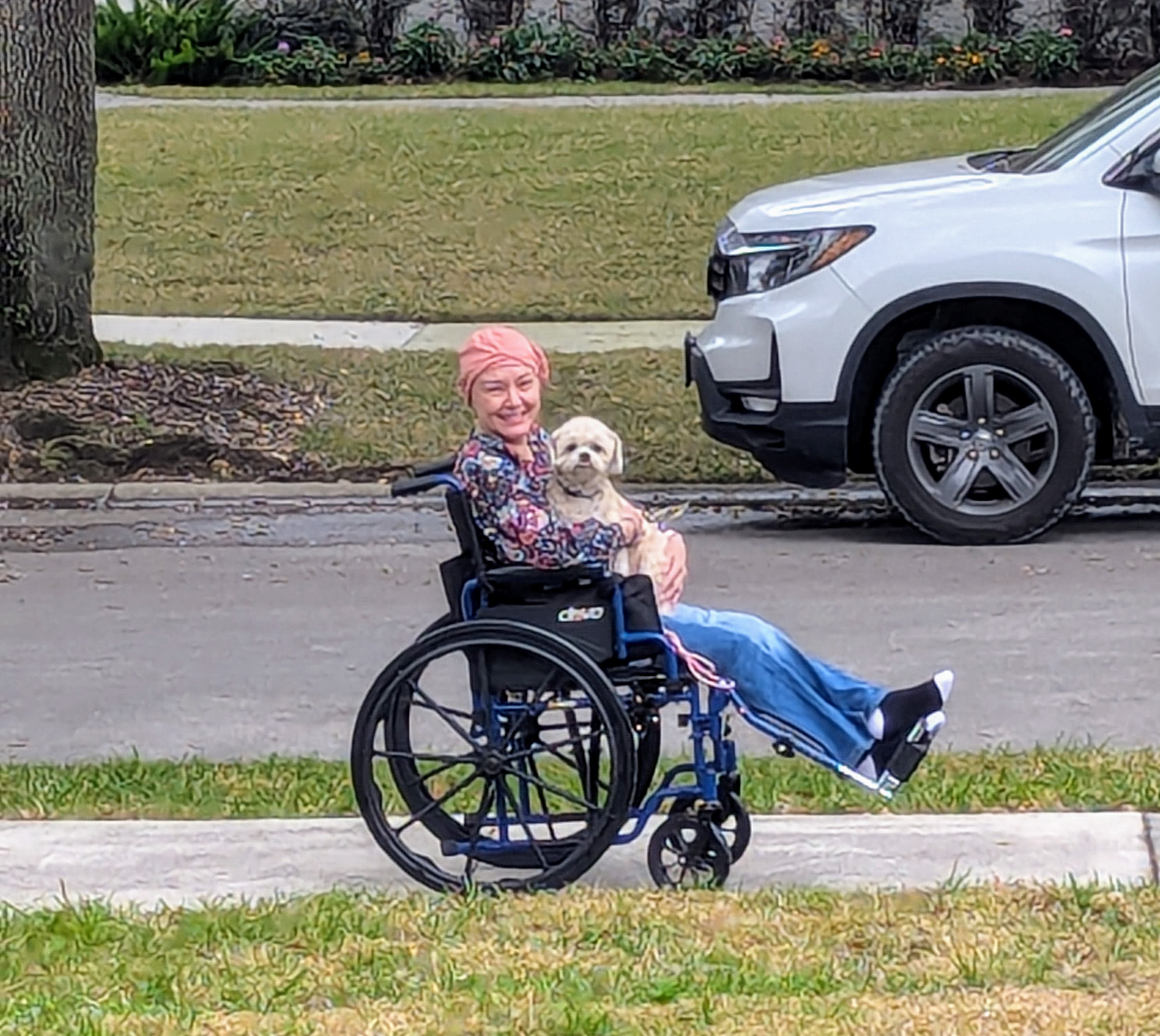
Yesterday was one of the hardest days yet. My wife, Sherri, whispered that she wished for death. Her pain was unbearable, even through layers of medication. Her bed sore reopened, two abscesses formed in her mouth, and the ache from her brittle bones and unhealed surgical site—after eight surgeries, two wound vacuums, and countless antibiotics—was relentless.
We took her to the dentist, who could do little more than write a referral to an oral surgeon. In that moment, I realized what Sherri already knew: sometimes, the course of care no longer offers a path worth taking. The procedures, the pain, the waiting—none promise comfort or meaningful recovery.
Yet, it takes a village. Her sister, her cousin, and her circle of friends have become our lifeline. Their presence gives her strength. She lights up when they visit, laughs, and feels alive again. But the cost is steep—those moments of joy are followed by hours of exhaustion and pain. Now, every visit, every appointment must be weighed against what it will take from her.
I see couples in the hospital—older than us—one sick, one trying to navigate the maze of care while barely able to support themselves. Too often, they end up alone in nursing homes, fading quietly. I’m grateful I’m still strong enough to help Sherri, even if I know there will be a toll later.
End-of-life care isn’t about heroics or procedures—it’s about presence. It’s about conserving what’s left of the body’s strength and surrounding the spirit with love. The truth is, medical science can extend life, but only community—family, faith, and friendship—can make it worth living.

When Love Meets the Machine
Day eight of what was supposed to be a three-day stay.
That sentence alone tells you everything about the state of modern healthcare.
As the disease progresses, it creates complications. Those complications summon specialists—each skilled, each confident, each siloed. They gather to form what they call a “care team,” but to the family it feels more like a committee meeting in slow motion.
Every decision takes time.
Every delay steals time.
Consensus becomes a currency that the patient can no longer afford to spend.
To them, this is process.
To us, it is life slipping away.
I find myself fighting thoughts I wish I didn’t have—the kind that whisper that the longer they keep her, the more they bill. That every new consult means another code, another line item, another form. I hate thinking that way. But when you’ve seen the system from the inside, you know how profit hides behind protocol.
Now, her body bears the evidence of the wait—bedsores, failed IVs, and pain so sharp it carves through every ounce of composure. Even the specialists with ultrasound guidance can’t find a vein. The solution: another procedure, another trip to the OR for a Hickman line. More anesthesia. More risk. More time.
And through it all, one question hangs in the air like a prayer caught in the static of bureaucracy: Can she just come home?
But to come home requires insurance approval, a signature in a portal, a code entered correctly. Somewhere between the nurse’s station and the insurance carrier, humanity gets lost. They don’t see her tears or hear her moans—they see a “case.” A “chart.” A “treatment plan.” While we watch the clock, waiting for Dilaudid that’s overdue and for someone—anyone—to notice that time is the one thing she doesn’t have.
This is what it feels like when love collides with a machine.

Compassionate Leadership in Consulting
Stability & Trust: Reflecting reliability and strength (rooted in veteran service).
Warmth & Compassion: Illuminating your human-centered, service-first orientation.
Professionalism & Clarity: Emphasizing structured, results-driven consulting.
Personal Touch: Highlighting individualized support and leadership.


VA Disability Claims: Clear and Simple Support
Filing for disability compensation through the Department of Veterans Affairs (VA) can be a complex and frustrating process. I provide a straightforward service designed to make it easier for veterans to receive the benefits they have earned.
Here is how I work:
- Payment only if benefits are awarded. My fee is twenty percent of the initial back payment from the VA. If an appeal is needed, the same structure applies. After that, the veteran owes nothing further.
- Based on federal standards. Because the VA does not set rates for consulting, I align with the Social Security Administration’s guideline of twenty-five percent and reduce it by five percent. This keeps my fee at twenty percent, below a recognized federal benchmark.
- No long-term obligations. Veterans can stop working with me at any time after providing notice. There are no hidden commitments or recurring fees.
- Everything in writing. I use a simple written contract that explains all terms clearly, in plain language. Veterans know exactly what to expect before we begin.
- Who I work with. Most of the veterans I serve are those who have had bad experiences with Veterans Service Officers (VSOs) or firms, those who have grown frustrated with the VA, and those who may not believe they deserve this benefit from a grateful nation.
My goal is to provide a fair, transparent, and effective path through the VA process, with clear terms and no surprises.
If you are a veteran who would like help filing for VA disability benefits, contact me at lou@loujswz.com
or 706-332-6005.
Profits Over Patients: Why the Insurance System is Failing Families
The health insurance industry has mastered one thing above all else: delay. What should be a simple claim submission turns into months of bureaucratic limbo, hidden behind jargon like “not yet built” or “waiting for processing.” These phrases disguise the truth—that while families wait for critical financial support, corporations sit comfortably on record-breaking profits.
We are told to expect 15 business days just for a claim to be reviewed, then another 30 to 60 days for processing. In the meantime, representatives admit that claims often sit in inboxes, unseen, until patients themselves call to shake the system awake. And yet these same companies proudly announce hundreds of millions in net income, raising their performance outlooks. The disconnect could not be starker: efficiency for shareholders, inefficiency for patients.
This is not a matter of capability. If profits can soar, systems can be fixed. More staff can be hired. Processes can be modernized. But the lack of urgency shows where priorities lie. Patients and families are left to wait, wonder, and absorb the financial strain—all while the corporations built to serve them choose margin over mission.
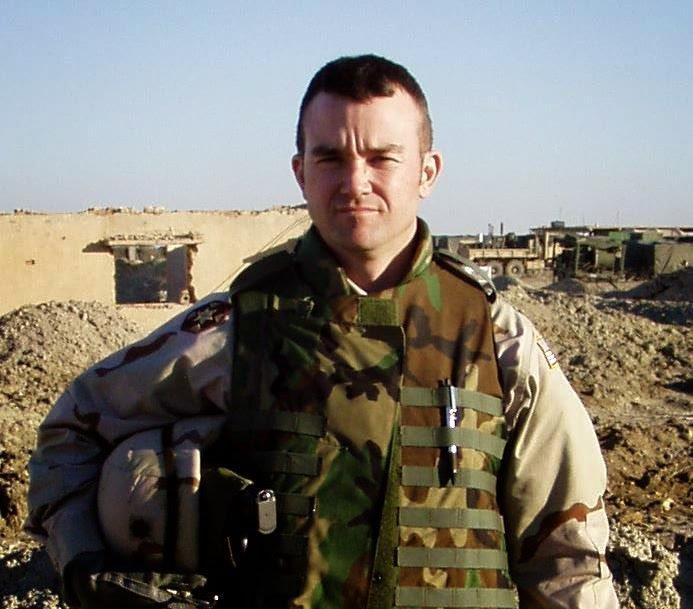
And this isn’t an abstract critique. This is personal. The claim in question was for my wife’s electric wheelchair—a necessity, not a luxury—purchased on June 9th. It cost more than $2,000. I wrote about it on June 23rd in my blog post “In the Blink of an Eye: Grace in the Midst of the Unthinkable”, where I shared how something as simple as mobility could restore dignity in the midst of suffering. Months later, the claim has still not been processed. Letters arrive contradicting what agents say, and the only reason any progress happens is because I chase it down.
For families like mine, these delays aren’t just numbers on a balance sheet. They are nights spent worrying, bills that pile up, and faith that slowly erodes. Representatives on the front line may show compassion, but they are trapped in a system designed to stall. Until the industry prioritizes people over profit, these “micro” frustrations will continue to echo the much larger, systemic failure of our healthcare system.
You can read the June 23rd post here: In the Blink of an Eye: Grace in the Midst of the Unthinkable


Why Nonprofits Should Register on SAM.gov: Key Advantages
Registering your nonprofit corporation in SAM.gov (System for Award Management) opens doors to
federal opportunities, funding, and resources while enhancing visibility and compliance.
- Eligibility for Federal Grants & Cooperative Agreements: SAM.gov registration is required to
apply for federal grants and assistance programs, ensuring your nonprofit is eligible for direct
funding opportunities. - Ability to Receive Federal Contracts: Nonprofits can compete for government contracts if their
services align with federal needs, such as training, research, logistics, or social programs. - Access to Federal Surplus Property: Through the General Services Administration (GSA),
registered nonprofits may qualify for federal surplus property programs, providing equipment and
resources at little or no cost. - Visibility in the Federal Marketplace: SAM.gov assigns your nonprofit a Unique Entity ID (UEI)
and CAGE Code, making it discoverable to federal buyers, prime contractors, and potential
partners. - Streamlined Compliance & Payment Processing: Federal agencies require SAM.gov
registration to set up EFT payments and verify compliance, ensuring your nonprofit receives funds
without delay. - Support for SBA & VA Certifications: SAM.gov registration is essential for maintaining
certifications like SDVOSB, HUBZone, and other socioeconomic designations, increasing
contracting opportunities.
Bottom Line: SAM.gov registration is a strategic step for nonprofits to access federal resources,
increase visibility, and strengthen credibility with government agencies and partners.
Hope we can help your organization too!