Blog Archives
Understanding LinkedIn Connections: A Reflection on Bias
As a lifelong learner and someone who prides himself on asking tough questions—of others and especially of myself—I recently posed one I hadn’t considered before: What do my LinkedIn connections say about me?
At first glance, the question might seem simple—just a casual curiosity. But the more I thought about it, the more I realized it held a mirror to my worldview, my network, and even my decision-making process. After all, our professional circles say something about how we seek advice, what we value, and—whether we admit it or not—how we perceive credibility and leadership.
So, I did what I’ve done my whole life investigated.
What I Found: A Familiar Reflection
The results were humbling, if not entirely surprising. My network largely looks like me: white, male, and with a military or law enforcement background. Not wrong, not intentional—but also not reflective of the broader society I serve or want to understand better.
This is the core of unconscious bias—it isn’t malicious or even deliberate, but it quietly shapes how we see the world and, in turn, how we act in it.
What I’m Doing About It: Intentional Inclusion
I believe in action, not just awareness. That’s why I’ve made a change to my daily habits. Every day, until I hit LinkedIn’s weekly connection limit, I intentionally send connection requests only to women—diverse in background, career, and experience.
I don’t overthink it. I see the picture and I click “Connect.”
No agenda beyond expanding my view of the world. My hope is that by increasing the diversity of my network, I’ll increase the diversity of thought I’m exposed to—and in doing so, improve the quality of the decisions I make, the advice I take, and the work I do.
Why It Matters
LOUJSWZ INC is committed to helping people grow—businesses, veterans, individuals—through integrity, process improvement, and purpose-driven consulting. But growth has to start with self-awareness.
This isn’t a story about checking a box. It’s about building a network that challenges me, reflects the real world, and ultimately makes me better at what I do—because I see more of the people I serve.
I still have a long way to go. But that’s the point of growth—it’s never over.
#UnconsciousBias #InclusiveLeadership #GrowthMindset #LOUJSWZ #VeteranOwned #LeadershipEvolution
The Art of Caregiving: Strategies for Support
“You have to go for a walk. Take a hot shower. Make sure you hit the rack every night early. I mean like 2000 hours at the latest. Every day is just like the military. You’re preparing for the next day.”
That’s what my buddy—another veteran who recently lost his wife to pancreatic cancer—told me. It stuck. Not because it was profound (although it is), but because it was familiar. It’s the kind of advice you’d hear before a deployment. Only now the mission is different. It’s longer. Harder in ways I never expected. And it’s personal.
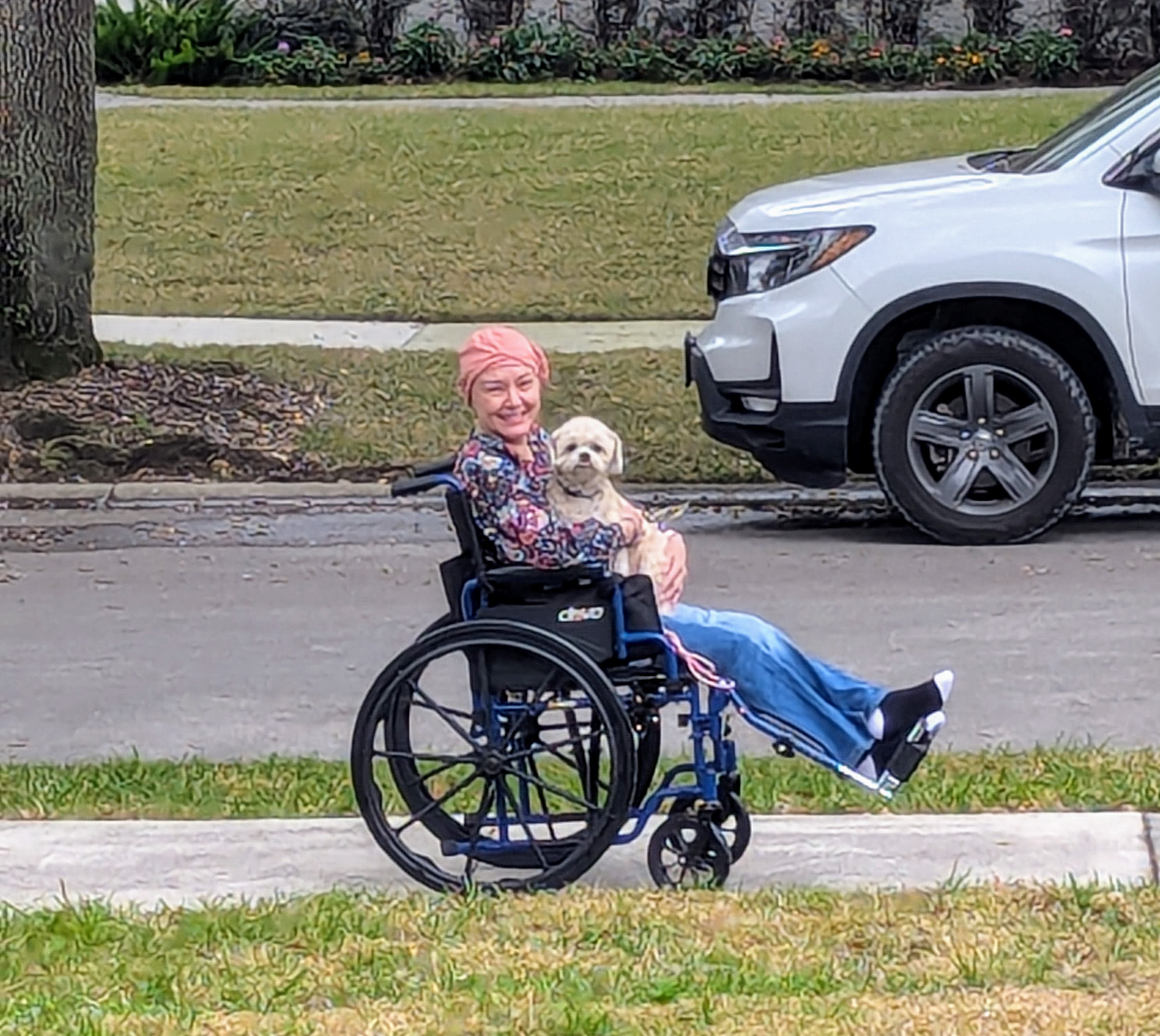
My wife Sherri is currently watching a movie in our EV, having lunch with our fur babies. It’s a simple solution to a hard problem: it spares her the pain of getting out of the car, into the electric wheelchair, into the house—only to turn around and do it all again in 35 minutes. During that time, my sister-in-law (who’s been a godsend) and I tag-teamed lunch prep, charged the chair, rotated the laundry, and coaxed our teenager into eating something besides cereal. That’s the rhythm. That’s the operation.
It’s funny how much this mirrors the military. In downtime, you prep for the next mission. That’s what caregiving is: a constant cycle of readiness. Because when your loved one is in pain, even helping them move can feel like a landmine of unintended harm. You don’t get to wing it. You plan, prep, adapt, and repeat.
And here’s the kicker: you can’t pour from an empty canteen.
My friend reminded me—like a good NCO would—that I need rest. That I need to recoup. That doing “me time” isn’t selfish; it’s strategic. And yet it’s one of the hardest things to do. How do you step away when the person you love is hurting? But if you don’t, you break down. And when you’re broken, you’re no good to them.
For me, that “me time” is Orange Theory Fitness. It’s more than a workout—it’s my decompression chamber. The people there know my story. They don’t flinch when I show up in a weird mood or vent a little too hard. They get it. It’s a release valve.
But caregiving can’t be done alone. It requires an extended care circle, and let me tell you—building that after the crisis hits is like trying to patch the roof in a thunderstorm. As JFK said, “Fix the roof when the sun is shining.” He wasn’t wrong. Having my sister-in-law here has changed everything. And when she’s not, our neighborhood friends step up in ways that humble me. They’re part of the circle now. I’ve learned that asking for help doesn’t make you weak—it lets people love you in real, tangible ways.
There’s something beautiful about how people show up when you let them. It reaffirms your faith in humanity, even on the hardest days. And if you’re lucky—like I am—you see that caregiving, as hard as it is, is also a sacred kind of service. One where love, not rank, leads the charge.
So here’s what I’ll leave you with:
Build your circle when the skies are clear.
Rest like it’s your responsibility—because it is.
And never underestimate the power of kindness, sweat equity, and a hot shower.
Because when it’s raining, all of that matters more than you’ll ever know.
The Joy of Collecting: Finding Meaning in Everyday Treasures
I’ve always collected things—medals, pennies, shark teeth, rocks, golf balls, even tire valve caps. Some of these were intentional, others accidental. But all of them, in their own way, represent little victories and moments of peace.
Just the other night, I went on a walk after dinner, a habit more about unwinding than fitness. I came back with five golf balls. Five. That might not seem like a lot to some people, but for someone who’s spent a lifetime collecting, five of anything in one outing is a haul. It got me thinking—not about golf balls, but about collecting, and more curiously, why I do it.
Let me start with this: I’ve begun using lost golf balls as my own personal economic indicator. A kind of SWAG (scientific wild-ass guess). I know it’s a stretch, but hear me out—if people are out playing golf in the middle of the week and losing $20 sleeves of balls without a second thought, then someone out there is doing alright. I’m no fan of trickle-down economics, but the existence of a well-funded slice of the population still swinging away gives me a small sense of hope that the world hasn’t completely unraveled. Still, that’s not why I walk. I walk to escape that kind of thinking.
This post isn’t about economics. It’s about collecting.
My father used to collect pennies he found on walks. Before that, as a boy, he collected stamps. I picked up the penny habit from him, and at one point, my collection was medals—military ones. Now? It’s golf balls, and teeth from long-dead sharks. And that’s the distinction I want to make. Stamps and medals feel like hobbies. You go out, you pay money, you build your collection. But to me, collecting has always been about the hunt—the unplanned, unscheduled discovery. The moment you spot something unexpected glinting in the grass or poking out from the sand. That’s collecting.
There’s real joy in that moment—when you pause, bend down, and confirm that yes, it’s a golf ball or a shark tooth or some little artifact the world left behind. It feels like you’ve won something. Like you’re seeing what others overlook. It might sound like a stretch, but in those moments I feel capable, even special.
Turns out, there’s science to back that up. Psychologists have long studied the drive to collect. Some say it’s tied to our ancestral instincts—early humans were gatherers, after all. Others say collecting brings order to chaos, structure to a fast-moving world. According to researchers, collecting can also provide a sense of control, personal identity, even legacy. But more than that, when we find something—especially something unexpected—our brain releases a hit of dopamine. The same reward chemical that fires when we eat good food, laugh, or fall in love. So yes, spotting a golf ball in the grass isn’t just coincidence—it’s chemically rewarding. No wonder I keep looking.
In those moments, I’m not thinking about work, or stress, or the headlines. I’m just walking. And collecting. And somehow, connecting to the people who came before me—my dad and his pennies, the long-lost owner of the golf ball, even the shark whose tooth found its way into my palm.
Collecting, for me, isn’t about things. It’s about finding meaning in the everyday. It’s about knowing that even in a world spinning out of control, there are still small, lost treasures waiting to be found.


Winning Proposals for Veteran-Owned Businesses
I just submitted my very first proposal to the State of Florida—and I have to admit, I didn’t think I stood a chance.
This wasn’t some minor RFP. Florida is recompeting its Management Consulting Services Consolidated Schedule, and I chose to compete in Service Category 4: Executive Leadership Development and Customized Training—one of nine powerful categories, all dominated by big-name firms with deep pockets and armies of employees.
But here I am. A veteran, a founder, a team of one, pushing through multiple websites, platforms, registrations, certifications, documents, file formats, and yes—those relentless character count limits—just to be considered viable. To even get a seat at the table.
And I made it.
It was not easy. The process was time-consuming, mentally exhausting, and filled with moments of doubt. But it was also one of the best learning experiences I’ve had as a business owner.
And here’s what I want other small businesses—especially my fellow Veteran-Owned Small Businesses (VOSBs) and Service-Disabled Veteran-Owned Small Businesses (SDVOSBs)—to know:
If you don’t try, you can’t win.
The State of Florida spent over $82 million on management consulting services last year alone. That’s not just a number—it’s an opportunity. One that we, as small, capable, values-driven businesses, can pursue. If you have the right NAICS codes, the right mindset, and the willingness to navigate the process, there’s a real path forward.
Yes, the back-office requirements are real. But compared to the federal government, the state-level procurement process is far more accessible. You don’t need a team of ten compliance officers. You just need to be intentional, organized, and committed to understanding the rules of the game.
I don’t know if I’ll win this one. But I do know this:
- I now understand how the process works.
- I can replicate and refine my submission.
- I’ve proven to myself—and maybe to others—that I belong at the table.
- And I’m ready to bring in some of the most mission-driven leaders I know to serve with excellence.
To anyone else out there feeling like a one-person army going up against giants: keep going.
The journey matters. The learning is real. And your impact—when your moment comes—will be undeniable.

Finding Strength in Fear: A Roadmap for Resilience
Sometimes we all need strength to persevere. Some days are harder than others. Some moments are like ice. Sometimes we need to have a plan to move forward. This is mine.
That feeling—of being stuck in place while time barrels forward like a freight train—is terrifying. The quiet becomes a roar. Your heart races while your body doesn’t move. It feels like you’re standing on a shore, watching a storm roll in, knowing you can’t hold back the waves.
But you’re not alone in this.
When fear takes over, survival doesn’t look like bravery. It looks like breathing, getting out of bed, putting one foot in front of the other, even if you don’t know where you’re going yet.
Here’s a small roadmap—just enough to get through one moment, then the next:
1. Name It
Say out loud (or write it down):
“I’m afraid of ____. I feel like ____.”
Giving fear a name takes away some of its power. It makes it something you are experiencing—not something that is you.
2. Shrink the Future
When the future feels unbearable, don’t try to live it all at once.
Try living just the next five minutes.
Then the next hour.
You’ll be surprised how far that can carry you.
3. Choose One Thing You Can Control
Maybe it’s taking a walk.
Making a cup of coffee.
Writing a message to someone you trust.
Control just one thing. That can be enough to anchor you today.
4. Let Others Be Your Strength
Even if you feel like a burden—you’re not.
Let someone carry a bit of this with you.
You don’t have to have the right words. Just say:
“I’m not okay. Can you just sit with me in this for a moment?”
5. Grace Over Guilt
If all you did today was survive—that counts.
You don’t have to fix everything. Not today. Maybe not even tomorrow.
You just have to keep showing up. You already are.
You asked how you can survive it.
You survive it the same way you’ve survived every hard thing before:
With a cracked heart and the quiet strength you don’t even realize you have.
And when you’re ready, we can talk about how to walk forward—not fast, just real.
I’m here for that walk whenever you are.


Learning from Mistakes: A DUI Reflection
For over 40 years, I have been behind the wheel, driving without incident—until now. I got a DUI. It still feels surreal to write those words. But the reality is, it happened, and I have no excuse. I have asked myself over and over, why did I not realize how dangerous and serious this was? And if I did, why did I not care?
Maybe it’s the weight of family burdens. Maybe it’s the inescapable reality of watching someone you love battle cancer—the most fatal form of it—a cruel, relentless adversary. Maybe it’s the anger and pain of an adolescent facing the potential loss of her mother. Maybe it’s depression, anxiety, or the gnawing exhaustion that comes with carrying so much.
The truth is, sometimes I feel like giving up on being the best version of myself. And I hate that feeling. But when it comes, it consumes me until something shakes me awake. This time, it was my DUI.
For years, I pushed the envelope. Since before I was 19, I thought I had control. How I managed to avoid hurting myself or someone else all these years is nothing short of a miracle. I could lie to myself and say, I never drove under the influence before—that I felt fine driving home that night. But that’s just not true.
I know chemistry. I understand biology. I know how alcohol affects the body, how it impairs judgment, and how much is too much. Yet, on that night, I just didn’t care. That’s the scariest part.
I passed the field sobriety test, but that didn’t matter. As I sat handcuffed in the back of the sheriff’s patrol car, all I could think was, It’s about time. I was taken to the DUI intake center and given a breathalyzer test—.10% BAC, 2% over the legal limit. From there, I was booked into the county jail and spent several hours waiting to post bail.
What came next was worse than my own shame. Scammers took advantage of the situation, calling my family including my children and friends, pretending to be a bail bonds company. My wife, out of concern, sent them $1,000 through Apple Pay. That loss, that embarrassment, was the worst part of the whole ordeal.
I am an Eagle Scout. An Army officer. I have built my life on helping others. And yet, I let this happen. It’s a humbling and haunting realization. But the response from my loved ones has been my saving grace. They did not ridicule me. They did not abandon me. Instead, they supported me, reminding me that one mistake—however significant—does not erase a lifetime of integrity and service.
This DUI is my wake-up call, my ghost of Christmas future, showing me what could be if I don’t change. It has forced me to confront my own choices, my vulnerabilities, and my need to truly take care of myself so I can continue taking care of others. I will take this harbinger seriously. I will strive to be better.
For those who may find themselves in a similar position, my message is simple: take responsibility, learn from it, and don’t ignore the signs. You don’t want to wait for your own wake-up call. Be better now.


