Blog Archives

Finding Strength in Fear: A Roadmap for Resilience
Sometimes we all need strength to persevere. Some days are harder than others. Some moments are like ice. Sometimes we need to have a plan to move forward. This is mine.
That feeling—of being stuck in place while time barrels forward like a freight train—is terrifying. The quiet becomes a roar. Your heart races while your body doesn’t move. It feels like you’re standing on a shore, watching a storm roll in, knowing you can’t hold back the waves.
But you’re not alone in this.
When fear takes over, survival doesn’t look like bravery. It looks like breathing, getting out of bed, putting one foot in front of the other, even if you don’t know where you’re going yet.
Here’s a small roadmap—just enough to get through one moment, then the next:
1. Name It
Say out loud (or write it down):
“I’m afraid of ____. I feel like ____.”
Giving fear a name takes away some of its power. It makes it something you are experiencing—not something that is you.
2. Shrink the Future
When the future feels unbearable, don’t try to live it all at once.
Try living just the next five minutes.
Then the next hour.
You’ll be surprised how far that can carry you.
3. Choose One Thing You Can Control
Maybe it’s taking a walk.
Making a cup of coffee.
Writing a message to someone you trust.
Control just one thing. That can be enough to anchor you today.
4. Let Others Be Your Strength
Even if you feel like a burden—you’re not.
Let someone carry a bit of this with you.
You don’t have to have the right words. Just say:
“I’m not okay. Can you just sit with me in this for a moment?”
5. Grace Over Guilt
If all you did today was survive—that counts.
You don’t have to fix everything. Not today. Maybe not even tomorrow.
You just have to keep showing up. You already are.
You asked how you can survive it.
You survive it the same way you’ve survived every hard thing before:
With a cracked heart and the quiet strength you don’t even realize you have.
And when you’re ready, we can talk about how to walk forward—not fast, just real.
I’m here for that walk whenever you are.


Learning from Mistakes: A DUI Reflection
For over 40 years, I have been behind the wheel, driving without incident—until now. I got a DUI. It still feels surreal to write those words. But the reality is, it happened, and I have no excuse. I have asked myself over and over, why did I not realize how dangerous and serious this was? And if I did, why did I not care?
Maybe it’s the weight of family burdens. Maybe it’s the inescapable reality of watching someone you love battle cancer—the most fatal form of it—a cruel, relentless adversary. Maybe it’s the anger and pain of an adolescent facing the potential loss of her mother. Maybe it’s depression, anxiety, or the gnawing exhaustion that comes with carrying so much.
The truth is, sometimes I feel like giving up on being the best version of myself. And I hate that feeling. But when it comes, it consumes me until something shakes me awake. This time, it was my DUI.
For years, I pushed the envelope. Since before I was 19, I thought I had control. How I managed to avoid hurting myself or someone else all these years is nothing short of a miracle. I could lie to myself and say, I never drove under the influence before—that I felt fine driving home that night. But that’s just not true.
I know chemistry. I understand biology. I know how alcohol affects the body, how it impairs judgment, and how much is too much. Yet, on that night, I just didn’t care. That’s the scariest part.
I passed the field sobriety test, but that didn’t matter. As I sat handcuffed in the back of the sheriff’s patrol car, all I could think was, It’s about time. I was taken to the DUI intake center and given a breathalyzer test—.10% BAC, 2% over the legal limit. From there, I was booked into the county jail and spent several hours waiting to post bail.
What came next was worse than my own shame. Scammers took advantage of the situation, calling my family including my children and friends, pretending to be a bail bonds company. My wife, out of concern, sent them $1,000 through Apple Pay. That loss, that embarrassment, was the worst part of the whole ordeal.
I am an Eagle Scout. An Army officer. I have built my life on helping others. And yet, I let this happen. It’s a humbling and haunting realization. But the response from my loved ones has been my saving grace. They did not ridicule me. They did not abandon me. Instead, they supported me, reminding me that one mistake—however significant—does not erase a lifetime of integrity and service.
This DUI is my wake-up call, my ghost of Christmas future, showing me what could be if I don’t change. It has forced me to confront my own choices, my vulnerabilities, and my need to truly take care of myself so I can continue taking care of others. I will take this harbinger seriously. I will strive to be better.
For those who may find themselves in a similar position, my message is simple: take responsibility, learn from it, and don’t ignore the signs. You don’t want to wait for your own wake-up call. Be better now.


Overcoming Life’s Challenges: Lessons from a Bike Ride
Not long ago, I found myself in a dark place. Life had become incredibly challenging: my wife is battling a severe illness, my relationship with my teenage daughter is strained, and my income has dried up. To cope, I turned to unhealthy habits—overeating, drinking excessively trying to seek temporary comforts. But those “fixes” never provided the lasting relief I craved; they really only intensify the darkness.
Then, life forced a change. My truck has been awaiting parts for three weeks, (not a Ford). Frustrated and without transportation, I dusted off my bike—something I hadn’t touched in over a year and a half, ever since I was hit by a car while riding it. Although I was only slightly injured it made me subconsciously avoid it. Hesitant at first, I eventually gave in to necessity.
Now, I ride 3.5 miles each way to my workouts at Orange Theory Fitness. Those seven miles a day have become more than just a commute; they’ve become a lifeline.
I’d forgotten how it felt to glide along the pavement, the cold wind on my face while music fills my ears. I’d forgotten the simple joy of moving under my own power, of feeling connected to the world as I navigate to my destination. In those moments on my bike, I feel truly alive.
This rediscovery has been transformative. It’s not just about the physical movement—it’s about the mental shift. That bike ride has reminded me that improvement begins with a single step (or pedal). One small action, no matter how insignificant it seems, can set off a chain reaction. For me, it’s been this daily ride.
It hasn’t solved all my problems—my wife is still fighting her battle, my daughter and I still have work to do, and life’s stressors haven’t disappeared. But it’s given me something invaluable: a sense of control, a feeling of progress, and a reminder that even in the darkest times, there’s a way forward.
If you’re feeling stuck, overwhelmed, or burdened by life’s challenges, I encourage you to start small. Take one step. Maybe it’s a bike ride, a walk around the block, a call to a friend, or just five minutes of quiet reflection. Whatever it is, try. Because that one small effort can grow into something bigger than you imagined.
For me, it’s been my bike. And I’ll keep riding, one mile at a time, until the road ahead feels a little brighter.
Finding Silver Linings in Unexpected Places
Life is unpredictable, and sometimes, the most unlikely situations reveal hidden blessings. Recently, I found myself navigating one such experience when COVID paid me an uninvited visit, but looking back, I see it as a moment of grace rather than misfortune.
On my way back to the hospital to be by my wife Sherri’s side, I began feeling unusually nauseous and headachy—a combination I’d never quite experienced. Despite being vaccinated and boosted, I followed my instinct to take a COVID test from the government-supplied kit Sherri had thoughtfully kept on hand. As soon as the liquid hit the strip, it confirmed my suspicion: positive.
Thankfully, we quickly tested everyone in the house, and Sherri was tested in the hospital. To our relief, all came back negative. Knowing I had listened to my wife’s advice and taken the test before exposing her to any potential harm was an overwhelming relief, especially considering her delicate health. Sherri’s fight with cancer has already brought so many challenges, and the last thing I wanted was to bring her more suffering.
As a veteran, I’m fortunate to receive care through the VA. They directed me to a local urgent care where I received a prescription to help alleviate the symptoms, but as I headed home, I faced another realization: it wasn’t safe to stay there. With extended family who had relocated from California to be with us and Sherri hopefully coming home soon, there was no choice but to get a hotel and isolate—my son humorously dubbed it “COVID jail.”
Isolation is not something any caregiver welcomes. For months, my days have revolved around taking care of Sherri, supporting her as she smiles through excruciating pain and endures round after round of chemotherapy. Yet, as I sat alone in the quiet of my hotel room, I realized how thankful I am for our extended family who stepped up in a way we could never have expected. They moved their lives across the country to help Sherri through her battle, filling in gaps that even the best of friends couldn’t manage long-term. Their presence has been an incredible gift.
In those quiet hours, I found myself thinking of everything my wife and I have been through, of the strength it takes to provide care day in and day out, and of the incredible people who have supported us on this journey. The forced solitude gave me a chance to regroup and recharge—a luxury many caregivers don’t get.
This unexpected turn of events became a blessing, one that reminded me of the importance of family, community, and listening to that inner voice, especially when it comes to caring for the ones we love. Even when life seems difficult or bleak, we can still find silver linings if we take a moment to look.
Divine Intervention in the Everyday: Lessons in Caregiving, Love, and Community
I never imagined I’d need to use a handicap space. When I received my 100% VA disability rating, I made a silent promise: I’d never park in those spaces. I felt strong and capable, able to walk to and from the store without issue. Florida even offers free license plates for veterans like me, allowing us to park closer to ease movement, but I couldn’t foresee a time when I wouldn’t be able to make it in and out of Publix on my own two feet.
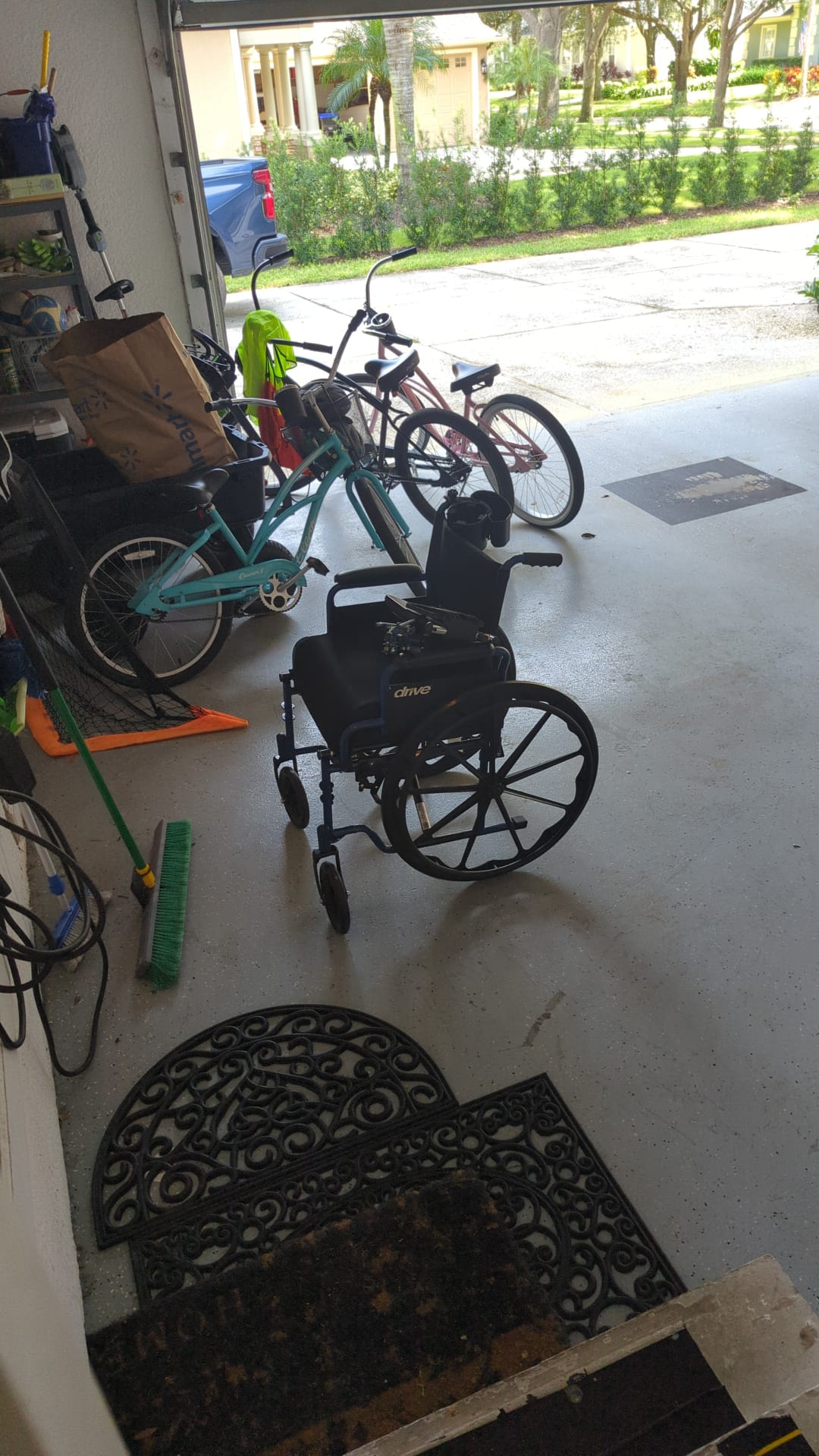
But life has a way of humbling us and revealing new perspectives. I recently found myself borrowing a wheelchair from our neighbors for my wife. She is fighting cancer again, and chemotherapy has made her legs ache with a pain. She is much like my father—strong-willed and independent, reluctant to ask for help or accept it. It’s one of the things I love most about her, this tenacity and resolve to live life fully on her terms. Yet, there are moments when emotion trumps logic, and she insists on walking, only to end up soaking her aching joints in a bathtub at 3 a.m.
Today, as I wheeled her around, I saw things differently. For the first time, I saw the purpose of those license plates I had so casually dismissed before. In a way, I felt the hand of God gently guiding me to see a deeper truth—that we all need help, and we will all be caregivers at some point in our lives. Rosemary Carter and Elizabeth Dole taught me this lesson, but life has reinforced it repeatedly.
I remember my father’s journey. A proud man, old school in every way, he despised the thought of using a wheelchair. For two hard years, he resisted help as he made his journey home, never once wanting to appear weak or dependent. I see so much of him in my wife now. She, too, is not accustomed to accepting help, yet her strength lies not just in her independence but in the love and resilience she shows every day, even through gritted teeth and stubborn defiance.
Our neighbors, older friends who have always been there for us, offered their wheelchair without a second thought. It’s moments like this that remind me of the power of community, of being a good neighbor. We help each other, not because we have to, but because it is a reflection of love, of being there when needed, without question or hesitation.
Sometimes, the carefully curated Instagram smiles need to be set aside so we can face reality. Life is not always picture-perfect; it is messy, challenging, and often painful. But it is also filled with grace, with moments of divine intervention that remind us of our purpose and our place in the world.
Today, my license plate makes sense. I see God’s plan unfold in the most unexpected ways. I am here, not just as a veteran with a rating but as a husband, a caregiver, a neighbor, and a servant of love. My wife’s determination to live life fully, even when it means being a little grumpy about the wheelchair, is a testament to the spirit we all share—the spirit to keep moving forward, to love fiercely, and to serve selflessly.
So, I embrace this role, this chance to support her in her journey, however she demands it. And in doing so, I see that God is indeed at work, weaving all these threads—divine intervention, caregiving, love, selfless service, and community—into a beautiful tapestry that is my life.