Author Archives: LOUJSWZ Inc.
When the Ramps Found Their Next Home
Yesterday was a good day.
My neighbor is a Vietnam veteran. Neuropathy has slowly been taking its toll on his legs and lower back, and lately he’s been falling more often. While talking with his daughter, who cares for him, she mentioned they wished they had a safer way to get down the front steps.
“Hold on a second,” I said.
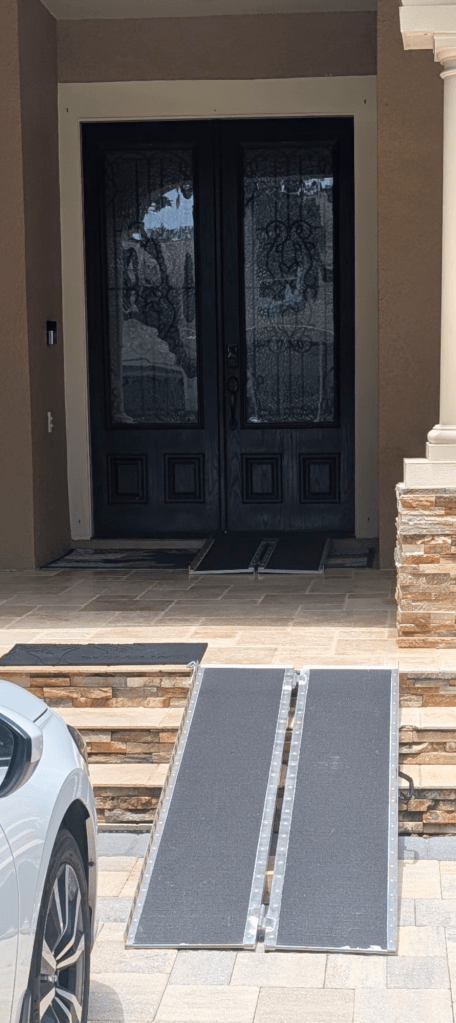
I walked across to my garage and brought back the two ramps for Sherri. Within minutes, we had them secured to their front steps. Just like that, they had a safer way for him to get in and out of his home.
It made me think.
It took us nearly a year to realize how much we truly needed those ramps. When you’re caring for someone with an incurable illness, watching them slowly lose their mobility, your mind is consumed by the next appointment, the next medication, the next crisis. Something as seemingly simple as installing a ramp somehow becomes another impossible decision. Which ramp? What angle? How do you secure it? Will it be safe? None of it feels simple when you’re living under constant pressure.
Yesterday, those hard-earned lessons allowed me to help someone else before it was too late. My neighbor gets to use the ramps while he can still walk with assistance, preserving a little more independence and, hopefully, preventing another fall.
I know Sherri loved this.
Even though she’s no longer here, her kindness continues to reach people she’ll never meet. Those ramps once carried her safely home. Now they’re helping a veteran like her father do the same.
Maybe that’s one of the quiet gifts of love. It doesn’t end when a life ends. It simply finds another person who needs it.
Yesterday wasn’t just about a couple of aluminum ramps.
It was another reminder that Sherri is still making the world a little better—through the people she changed, the lessons she taught, and the love she left behind.
Is This What Healing Feels Like?
Lately, I’ve been asking myself questions that don’t seem to have answers for.
Does everything eventually become routine?
Does everything that is new eventually become old?
They call it the “daily grind” for a reason, don’t they?
When does something lose its luster?
And perhaps the harder question…when do we?
The past year has changed me in ways I never expected. Losing my wife after watching her fight with every ounce of strength she had, trying to raise my daughter, helping fellow veterans navigate a system that often overwhelms them, trying to build a business with purpose—it has all been meaningful. Yet, at times, it has also been exhausting.
People sometimes tell me how strong I am.
The truth is, strength isn’t the absence of questions. Sometimes it’s simply continuing to put one foot in front of the other while carrying them.
Why do I struggle to feel purpose on some days when I know my work changes lives?
Why does my soul sometimes feel quiet instead of alive?
It isn’t that I lack free will. Every day I choose to move forward.
It isn’t that I cannot love. If anything, loving deeply has become both my greatest gift and my greatest source of pain.
So what is it?
Is my tank full—but filled with sand instead of water? Have years of responsibility, military service, loss, caregiving, and simply surviving filled every available space until joy has difficulty finding room?
Or is it something simpler? Is my brain still healing from grief? Are the chemicals that shape emotion simply trying to find their balance again?
I honestly don’t know.
What I do know is this: purpose doesn’t seem to be something we find once and keep forever. It fades. It changes. It asks us to search for it again and again.
When I help a veteran receive benefits they earned decades ago, I see purpose.
When I teach someone how to navigate the VA system so they can eventually do it themselves, I see purpose.
When my daughter smiles, I see purpose.
But even purpose doesn’t erase grief. It simply gives grief somewhere meaningful to stand.
Maybe that is what healing really is.
Not waking up one morning and feeling whole again.
Not forgetting the people we’ve lost.
Not pretending life is the same.
Maybe healing is learning that even when life loses some of its shine, it still has value. That even when our soul feels quiet, it is still there. That even when we don’t have all the answers, we can still choose kindness, service, and love.
I don’t know if everything eventually becomes ordinary.
I do know that the people we help, the lives we touch, and the love we give never truly lose their value.
Perhaps that’s enough for today.
Tomorrow, I’ll ask the questions again.
And I’ll keep walking anyway.

On Azimuth LLC Achieves SBA Certification as a Service-Disabled Veteran-Owned Small Business (SDVOSB)
Windermere, FL — July 1, 2026 — LOUJSWZ INC proudly congratulates On Azimuth LLC on achieving official certification as a Service-Disabled Veteran-Owned Small Business (SDVOSB) through the U.S. Small Business Administration (SBA) on June 30, 2026.
Led by Lieutenant General (Ret.) David Wilson, U.S. Army, On Azimuth LLC provides strategic leadership, organizational strategy, executive advisory, and global logistics consulting services to federal and commercial clients. This certification allows the company to compete for federal set-aside and sole-source opportunities reserved for eligible veteran-owned businesses, including additional contracting opportunities through the Department of Veterans Affairs.
Reflecting on the achievement, LTG (Ret.) Wilson said:
“I did this with the encouragement of my Citadel classmate, Louis J. Schwartz, who helped me see that pursuing this certification could give my business a competitive advantage because certification differentiates your business. Instead of competing against thousands of firms, you may compete against only dozens—or even fewer—for veteran set-aside opportunities. That significantly improves your probability of winning contracts.”
He also encouraged fellow veteran entrepreneurs:
“Don’t be shy about reaching out to your networks and seeking assistance. It can be a true difference maker. If you’re certified as a VOSB or SDVOSB, you become eligible for additional opportunities with the Department of Veterans Affairs under the Veterans First Contracting Program—opportunities unavailable to companies without certification.”
Louis Schwartz, President of LOUJSWZ INC, added:
“Helping fellow veterans build successful businesses is one of the most rewarding parts of what we do. Every veteran-owned company that earns SBA certification expands opportunities not only for that business but also for federal agencies seeking experienced, mission-focused partners.”
Congratulations to Lieutenant General (Ret.) David Wilson and the entire On Azimuth LLC team on this outstanding achievement.
About On Azimuth LLC
On Azimuth LLC is a Service-Disabled Veteran-Owned Small Business (SDVOSB) providing strategic leadership, organizational transformation, executive advisory, and global logistics consulting services. Founded by Lieutenant General (Ret.) David Wilson, the company leverages decades of senior military leadership and enterprise logistics experience to help government and commercial organizations improve operational readiness, strategic execution, and organizational performance.
About LOUJSWZ INC
LOUJSWZ INC is a veteran-owned consulting firm specializing in SBA certifications, federal registrations, and government contracting readiness. The company has helped numerous veteran-owned businesses successfully obtain SDVOSB and VOSB certification while also assisting veterans in pursuing the VA disability benefits they have earned through military service.

A Button, a Lesson 45 Years in the Making
Today I sewed a button back onto my favorite shirt and repaired a split seam in a pillow.
Neither job took very long, but when I finished, I realized I had just used a skill I learned more than 45 years ago as a Boy Scout.
My Scoutmaster, William Lee Kitchel, was a remarkable man. He was a Navy veteran of the Second World War who served aboard a battleship and was wounded during a kamikaze attack. Later, he served again, this time in the Air Force during the Korean War. He was demanding, disciplined, and believed that young men learned responsibility by doing things themselves.
Every Scout in our troop sewed on his own merit badges and patches. There were no shortcuts and no “Mom will do it.” When I earned my first three merit badges, I was handed a needle, thread, and instructions to sew them on myself.
Like so many families, my mother kept a Danish butter cookie tin that contained everything except cookies. Inside were needles, thread, buttons, pins, and years of accumulated sewing supplies. She gave me a needle, some thread, and a T-pin, and I went to work. My first attempts looked terrible, but Mr. Kitchel expected us to do it correctly. He accepted no excuses and suffered no fools. Over time, I became quite good at sewing. He even taught us traditional Seminole patchwork sewing, a skill I never imagined would stay with me for life.
Back then, I thought I was simply learning how to put patches on a Scout uniform.
Today I realized he was teaching something much larger.
The woman who quietly fixed buttons, repaired torn clothes, and mended the little things around our home—my wife, Sherri—is gone now. Today, there was no one to hand my favorite shirt to. So I threaded the needle myself, replaced the missing button, and repaired the pillow.
That shirt is my favorite because of a photograph. It shows Sherri sitting on my lap during one of our vacations, smiling with the biggest, brightest smile. It was probably one of our first selfies. Every time I see that picture, it reminds me of her joy, and it makes me smile too.
As I finished sewing today, I realized that William Lee Kitchel had taught me something without either of us knowing it. He wasn’t just teaching a Boy Scout to sew. He was teaching self-reliance, patience, pride in doing a job well, and the confidence to care for the things—and the people—that matter.
Some lessons don’t reveal their true value until decades later.
Thank you, Mr. Kitchel, for giving me a skill that has lasted a lifetime, and for teaching me something far greater than sewing.

Don’t Leave a Service Member Behind: Empowering Veterans to Navigate VA Disability Benefits
Most of my veteran clients come to me the old-fashioned way: through referrals and word of mouth.
I am not currently accredited by the Department of Veterans Affairs, although I began that process nearly three years ago. About a year ago, the VA contacted me to ask if I was still interested. I told them absolutely. Since then, I have been waiting to hear back.
In the meantime, veterans continue to need help.
Recently, a veteran over the age of 50 was referred to me. He was rated at 60% disability but was afraid to file any additional claims because he had heard a common myth: “If I ask for more, the VA will take away what I already have.”
After reviewing his file, we discovered that a bilateral condition had never been properly claimed. The issue wasn’t that he was asking for something new—the original rating simply wasn’t correct.
Within two weeks, his rating increased from 60% to 80%.
We then identified several secondary conditions that were directly related to his service-connected disabilities. Within two months, his rating increased again to 90%.
But the most important part of this story is not the rating increase.
Throughout the process, I taught him how the VA disability system works. I explained evidence requirements, secondary conditions, effective dates, and how to build a strong claim.
Armed with that knowledge, he continued the process himself.
Today, he has achieved the correct rating of 100%.
That is success.
Not because I helped him. Because he learned how to help himself.
The Numbers Tell the Story
There are approximately 6 million veterans who have never been evaluated for VA disability compensation. Many left military service before programs such as the Benefits Delivery at Discharge (BDD) process became common.
At the same time, there are only about 2,000 accredited Veterans Service Officers (VSOs) across the country.
Let’s do the math.
Assume:
- A compensation claim review takes an average of 135 days (midpoint between 120 and 150 days).
- A VSO works 40 hours per week.
- A VSO works 50 weeks per year.
Even if every VSO could somehow manage one complete compensation review every 135 days, the system could only process about 5,400 veterans per year nationwide.
At that rate, it would take more than 1,100 years to review 6 million veterans.
Even if we assume far greater efficiency, the reality remains the same:
There are far more veterans needing assistance than there are professionals available to help them.
The Solution: Veteran Helping Veteran
We cannot solve this challenge by relying solely on VSOs, attorneys, claims agents, or consultants.
We must empower veterans.
Every veteran who learns how the system works should help another veteran.
Every veteran who successfully navigates the process should teach someone else.
Every veteran who receives benefits they earned should encourage a fellow service member to get evaluated.
The goal is not dependence.
The goal is education.
The goal is confidence.
The goal is ensuring that every veteran understands the benefits they earned through their service.
The veteran in this story did exactly that. He overcame fear, learned the process, achieved the correct rating, and is now in a position to help others.
That is how we create a force multiplier.
One veteran helping another.
Then another.
Then another.
Because at the end of the day, we all swore an oath to leave no one behind.
That principle should not end when military service does.
Don’t leave a service member behind. Help them get the benefits they earned. Teach them how the process works. Empower them to help the next veteran.
Danny’s Success Strategies Achieves Veteran-Owned Certification
LOUJSWZ INC proudly congratulates DANNY’S SUCCESS STRATEGIES LLC on officially attaining both Veteran-Owned Small Business (VOSB) and Service-Disabled Veteran-Owned Small Business (SDVOSB) certification through the U.S. Small Business Administration (SBA) and the General Services Administration (GSA).
This achievement represents far more than a designation. It validates the company’s ownership, governance, operational integrity, and eligibility to participate in federal programs specifically designed to increase opportunities for veteran entrepreneurs who have served and sacrificed for our nation.
Across the United States, there are millions of veteran-owned businesses, yet only a relatively small percentage complete and maintain the formal federal verification and certification process required for official SDVOSB recognition. Because of this, attaining certification is a meaningful accomplishment that demonstrates professionalism, accountability, and readiness to support government and commercial customers alike.
For DANNY’S SUCCESS STRATEGIES LLC, this certification creates significant opportunities, including:
- Eligibility to compete for federal SDVOSB set-aside contracts
- Increased visibility within federal procurement systems
- Enhanced credibility with prime contractors and teaming partners
- Greater access to supplier diversity programs
- Recognition as a verified veteran-led organization committed to service and excellence
The benefits also extend directly to customers and partners. Organizations that work with certified SDVOSBs gain access to highly motivated, mission-focused businesses that often bring leadership, discipline, adaptability, and operational resilience developed through military service. Federal agencies and large corporations additionally benefit by meeting important small business and supplier diversity objectives while supporting the veteran community.
At a broader level, every successful SDVOSB certification strengthens America’s commitment to those who served. Veteran-owned businesses continue to play a vital role in the U.S. economy by creating jobs, supporting local communities, and bringing values-based leadership into both the public and private sectors.
LOUJSWZ INC is honored to have assisted in supporting this effort and remains committed to helping other veteran entrepreneurs navigate the often complex SBA and GSA certification processes. From organizational documentation reviews and eligibility guidance to SAM.gov alignment and strategic positioning, LOUJSWZ INC helps businesses better understand the importance of official federal certifications and how to leverage them for long-term growth and opportunity.
We congratulate DANNY’S SUCCESS STRATEGIES LLC on this important milestone and look forward to their continued success serving customers with the professionalism, integrity, and leadership that define the veteran business community.


Serendipity
There are moments in life that feel accidental at first glance, but later settle into your heart as something much deeper. Moments where friendship, love, timing, grief, and grace all quietly intersect in a way that cannot simply be explained away as coincidence.
This past week, I took my first trip in four years without the overwhelming dread or guilt of leaving my wife behind. That alone felt strange to me. For years, every decision, every outing, every mile traveled carried the weight of caregiving and concern. Even moments that should have been joyful often carried an undercurrent of worry.
But this trip was different.
I traveled to Charleston to attend the graduation of the son of one of my classmates from our alma mater. It was a wonderful celebration filled with memories, laughter, and the strange realization that time continues to move forward whether we are ready for it or not. I stayed with another longtime classmate who still works at the school, and for a few days, I was surrounded by nearly forty years of friendship and shared history.
The morning after the celebration, I woke early and sat having coffee with my friend’s wife, someone I have also known for nearly four decades. We spoke quietly in that way people do in the early morning, before the world fully wakes up.
She shared how they had recently moved her parents from Maine to live near them in an independent living facility. Her father suffers from Alzheimer’s, and her mother from dementia. We talked about the difficult reality families face when navigating those diseases.
One of the strange truths about Alzheimer’s is that, as horrible as it is, there is often a somewhat defined progression. Dementia, however, can be incredibly broad and unpredictable. Symptoms vary wildly. Behaviors change suddenly. Good days and difficult days arrive without warning. For families who have never walked through it before, it can be exhausting, confusing, heartbreaking, and frustrating all at once.
Even after only a couple of months, I could already see the emotional toll it was taking on her.
She explained how her mother had insisted on hip surgery because she believed it would improve her quality of life, but instead, it had left her nearly immobile.
And immediately, my mind went to Sherri’s scooter.
For months, it had been sitting quietly in Sherri’s office gathering dust. A bright pink mobility scooter that no one else could ever possibly mistake for their own.
Of course it was pink.
Sherri insisted on pink.
Not just any pink scooter either. I had to drive more than one hundred miles to find one because she refused to settle for anything less than the exact shade she wanted to match her love of Lilly Pulitzer colors and style. Then she decorated it herself. She made a Lilly Pulitzer-style cover for the back seat, and because she was so tiny, we even added a piece of pink foam so her feet could comfortably reach the pedal.
That scooter was unmistakably hers.
As my friend’s wife spoke, I realized that the scooter sitting unused in Orlando could suddenly become something meaningful again.
I told her, “I have something that can help.”
It is amazing how easy it is nowadays to move something across the country. There truly is an app for everything. Within a short period of time, I found a kind gentleman willing to transport the scooter from Orlando to Charleston the very next day.
And just like that, Sherri’s little pink scooter was headed north to help another family carrying a burden of love and caregiving.
I sat there afterward thinking about how strange and beautiful life can sometimes be.
What are the odds that I would finally take my first trip away?
What are the odds that this conversation would happen over early morning coffee?
What are the odds that a scooter sitting unused for months would suddenly become exactly what another family needed?
Some people call that coincidence.
I do not.
I believe there are moments of divine intervention woven quietly into our lives. Moments where love continues moving long after someone is gone. Moments where friendship creates opportunities for compassion. Moments where grief transforms into purpose.
Serendipity is a funny thing. It often arrives carrying both sorrow and joy at the same time.
What touched me most was realizing that even now, Sherri is still helping people.
Even now, her kindness, personality, style, stubbornness, humor, and love are still moving through the world in tangible ways. A pink scooter decorated by her own hands is now going to reduce the burden on another daughter caring for her parents.
And honestly, I think that would make Sherri smile.
Life can be unbelievably difficult. Illness, loss, aging, caregiving, and grief all remind us how fragile we really are. But friendship, love, and compassion remind us that none of us were ever meant to carry those burdens alone.
Sometimes the greatest acts of grace are not the massive miracles.
Sometimes they are simply a cup of coffee, an old friendship, a heartfelt conversation, and a pink scooter finding its next purpose exactly when it is needed most.

When I think of Sherri,
The first thing I think about is her aura. Sherri had a golden aura, like a sunrise—quiet, calm, and bright, full of promise.
The first time I saw her in person was on our first date. It was at Seasons 52 on the perimeter in North Atlanta. I was sitting at the bar eagerly awaiting to finally meet her.
When I turned and saw her, I was struck by her refined, elegant presence and her physical beauty. I felt her aura immediately. I knew in that instant through her smile that there was something extraordinary about her. Yes, she was physically beautiful, but it was always so much more than that.
Long before I saw her face, I had already come to know her character through months of writing to each other through emails as we seemed so busy with life to meet. She had strength, depth, and a goodness that shined from within. I had read it in every email she wrote and this aura I felt proved it.
Her life shaped the strength that all of us came to admire. Born in Vietnam during the war in a U.S Army Hospital. She was raised in a family that through all the setbacks they never gave up on each other. Losing both of her parents in tragic accidents at a young age, she still rose above every hardship. She worked full time, cared for her siblings, and earned both her undergraduate and graduate degrees paying for her schooling herself. She never bragged about any of it as that wasn’t Sherri. She was a woman of action not words. Extraordinary in every way, yet humble enough to rarely speak of herself.
Sherri was the most patient person I have ever known, and when I say patient, I mean years, hell she was married to me. She saw the good in people even when others could not. She listened beyond words. That was one of her greatest gifts. No matter the country, culture, or language, people felt her kindness, her serenity, and her goodness. Animals felt it too. Every creature we had, naturally found their way to her. She made every living thing feel safe but she was also tough.
She was very tough, but always fair. That fairness is why she rose in positions at State Farm, where she led hundreds by her daily example of servant leadership. I still smile thinking about a day in Las Vegas working for State Farm. She was handling an accident claim for Andre the Giant. I think we all have heard of him but if you haven’t, he was a world-famous professional wrestler that stood 7 foot 10 and weighed 500 pounds. His Rolls-Royce had been hit, and he was furious that the rental car did not match the kind of vehicle he was used to driving. He demanded to come into the office and deal with her face-to-face. That poor fellow had no idea who he was dealing with. Our Sherri, never intimidated by anyone, calmly handled the situation and sent him on his way satisfied, I assume with a regular car that he was due. That was her—steady, fearless, fair, and always in command without ever raising her voice. She was strong without ever making a person feel small.
She had vision in everything she did—whether it was leadership, fashion, family, or the way she could see the ripple effects of decisions four and five levels deep. I used to say if I had known Sherri when I first came into the military, I would have been a four-star general, because she had that rare ability to bring people together and lead them without ever needing the title. She was the matriarch of our family.
I relied on her so much. To smooth things, I roughed up. To make it all better for us all. Everyone asked her without knowing to do that for them. She was our Sage. She just made us better.
In the hardest chapter of her life and her life was hard; she showed us all what true strength and love looked like.
I do not think you can fully understand her character until you understand what she endured in her final years. The pain she carried, the stoicism she showed, the way she kept smiling even in the most horrific moments and through it all she was still thinking and doing for others.
When her body was gone, she endured for her family to be here for as long as she could; she never never gave up. In the middle of her own suffering, she gave counsel from the bed side and listened to all of her friends and family while telling them everything would be ok. For the last year she could not walk, Her mouth was disfigured from the malignancies. She suffered six broken bones from the pressure, eleven hospital stays and surgeries, every movement was painful but she was always smiling. The last picture I have of her was with a Reese’s peanut butter cup and her smile the day before she died.
Sherri was my Briar Rose, my partner, my example of grace, toughness, fairness, beauty, and vision. She had a way of making people feel seen, heard, and loved.
Her life was not only beautiful in how she lived it, but in how she lifted every one of us around her.
And though her physical presence is gone, her aura—the same golden aura I felt the first time I saw her—still rises with us
and will always rise with us every new day.
May she rest in peace.

What is planted in love is rarely lost.
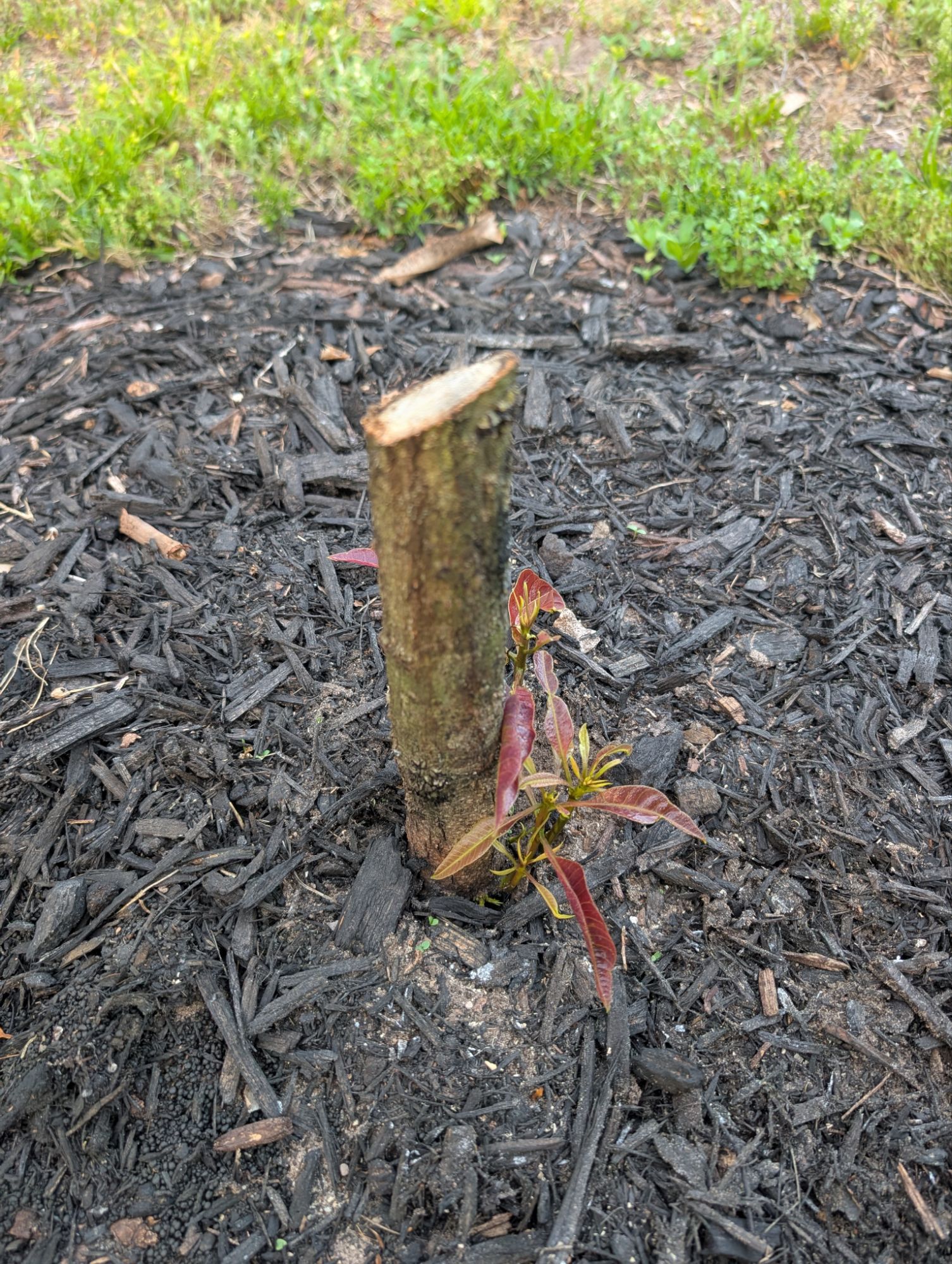
After the freeze, I posted a question on “Nextdoor” about our Kent Mango trees. I asked; are they beyond saving? They were so badly burned in the bitter frost even though I covered them and wet them. A gentlemen posted a response to cut them to the stump and they might grow back.
I hesitated for a month or two. I first cut the leaves, then the branches, then finally all the way to the stump. It’s been a month or two now, maybe even three.
I have lost track of time since Sherri has passed. I had given up on the two little Kent Mango trees. Her favorite variety. It took me months to find them for her.
Lo and behold, they’ve come back.
Sherri’s gone now.
I planted these trees for her. She did get to see them and they did even bloom once, but the frost killed them. But did it really? Like Sherri, they’re still here..
Like Sherri, everything she touched, is still here, still growing, still shining.
Her physical presence was touched by something so cruel and final, and yet what she planted in this world—through love, service, grace, banana bread, courage, family, and the way she made people feel seen—did not die with the frost. It remained in the roots of everyone she loved.
It will always be.

The Missing Millions: Why So Many Veterans Still Lack Disability Ratings
In the United States today, a significant portion of the veteran population remains without a service-connected disability rating—even though many receive ongoing care from the Department of Veterans Affairs (VA). This gap affects millions and stems from long-standing structural issues and common misunderstandings.
How Many Veterans Are Unrated?
Recent federal data shows:
17.8 million veterans currently live in the U.S.
Only 5.2 million (about 30%) have a service-connected disability rating.
That leaves roughly 12.5 million veterans without a rating, including an estimated 6 million who separated before disability assessments became part of the mandatory out-processing process.
Before the mid-1990s and early 2000s reforms, the DoD did not require a disability evaluation as part of separation or retirement. Millions of veterans left service with no assessment and never filed later simply because the process was unclear or unknown.
Two VA Systems — and They Don’t Communicate
A critical fact many veterans do not know:
VA Healthcare and VA Disability Compensation are completely separate systems.
Receiving VA medical care does not create or update a disability rating.
Diagnoses, imaging, or treatment inside VA healthcare records are not reviewed for disability compensation unless a veteran files a claim.
No condition—primary or secondary—moves into the disability system automatically.
Many veterans assume that being treated for chronic pain, orthopedic injuries, sleep issues, or mental health conditions means their disability file is being updated. It isn’t. Only a formal claim triggers review.
The Impact on Veterans
Millions of veterans who never filed a claim at all.
Veterans with worsening conditions who never requested rating increases.
VA healthcare patients with serious diagnoses that were never evaluated for service-connection.
Missed compensation, lost benefits, and reduced access to programs tied to rating thresholds.
A single misconception—“VA healthcare updates my disability rating”—can cost a veteran years of deserved benefits.
What Every Veteran Should Do Now
To ensure disability benefits reflect current health conditions, veterans should:
1. Review their conditions regularly
Check for new diagnoses, worsening symptoms, or secondary conditions.
2. File new or supplemental claims
Use VA.gov, mail, or accredited submission channels to request evaluation.
3. Understand the system
VA healthcare records do not update disability ratings. A claim must be submitted.
4. Track secondary conditions
Issues like sleep apnea, depression, migraines, radiculopathy, GERD, or joint degeneration often stem from service-connected primaries.
Veterans who separated before mandatory disability evaluations around 2010 are especially vulnerable because many were never informed of the modern process.
Closing the Gap
With only ~30% of veterans holding a disability rating—and millions eligible but unrated—awareness is essential. Understanding that VA healthcare and VA disability compensation operate independently is the first step toward ensuring every veteran receives the benefits they earned through service.
Need Help Understanding Your Claim Path?
If you or a veteran you know is unsure about eligibility, secondary conditions, or how to properly file, guidance is available. Filing a claim is not automatic—but it can be straightforward when you understand the rules and requirements.


