Blog Archives

What will my life be like in 3 years?
I dare not answer the question.
That was my first response when someone asked where I see myself in three years. Without hesitation, fear stepped in — not fear of failure, but fear of imagining life beyond now. Beyond her.
Yesterday, my wife finalized her cremation plans. I’ve done this before — for my sister, for my father. Each time, it became a necessary transaction. Paperwork, signatures, polite condolences exchanged over a table that felt too small for the weight in the room. The funeral director came to the house. We completed the forms. She paid for her services. Efficient. Respectful. Businesslike.
It’s best to do this before it happens, they say — so there’s one less thing to cause anxiety and pain.
But is that really true? Or is it that I just didn’t want to do this again?
Because the truth is, no matter how many times I’ve faced loss, I still don’t know how to prepare for it. I can manage logistics, but not emotions. I can sign the papers, but not the permission slip to move forward.
When I think about the future — traveling, my children, my new grandbaby — I feel guilty. There’s a horrible tension between the yearning to be free and the desperate wish for this stage of life to never end. How do you reconcile wanting relief and wanting permanence at the same time?
Maybe that’s what being human really is — living inside the contradiction.
We spend our lives trying to control time, plan for tomorrow, build systems, write goals. But life keeps reminding us it doesn’t belong to us. It moves with or without our consent.
Three years from now, I don’t know where I’ll be. Maybe I’ll be standing somewhere new, lighter but not the same. Maybe I’ll still wake up some mornings expecting to hear her voice. Maybe I’ll finally find a kind of peace in the not-knowing.
Because the truth is, none of us can control life. We can only honor it
Where will I be in 3 years…..


It Takes a Village: The Realities of End-of-Life Care
Yesterday was one of the hardest days yet. My wife, Sherri, whispered that she wished for death. Her pain was unbearable, even through layers of medication. Her bed sore reopened, two abscesses formed in her mouth, and the ache from her brittle bones and unhealed surgical site—after eight surgeries, two wound vacuums, and countless antibiotics—was relentless.
We took her to the dentist, who could do little more than write a referral to an oral surgeon. In that moment, I realized what Sherri already knew: sometimes, the course of care no longer offers a path worth taking. The procedures, the pain, the waiting—none promise comfort or meaningful recovery.
Yet, it takes a village. Her sister, her cousin, and her circle of friends have become our lifeline. Their presence gives her strength. She lights up when they visit, laughs, and feels alive again. But the cost is steep—those moments of joy are followed by hours of exhaustion and pain. Now, every visit, every appointment must be weighed against what it will take from her.
I see couples in the hospital—older than us—one sick, one trying to navigate the maze of care while barely able to support themselves. Too often, they end up alone in nursing homes, fading quietly. I’m grateful I’m still strong enough to help Sherri, even if I know there will be a toll later.
End-of-life care isn’t about heroics or procedures—it’s about presence. It’s about conserving what’s left of the body’s strength and surrounding the spirit with love. The truth is, medical science can extend life, but only community—family, faith, and friendship—can make it worth living.

When Love Meets the Machine
Day eight of what was supposed to be a three-day stay.
That sentence alone tells you everything about the state of modern healthcare.
As the disease progresses, it creates complications. Those complications summon specialists—each skilled, each confident, each siloed. They gather to form what they call a “care team,” but to the family it feels more like a committee meeting in slow motion.
Every decision takes time.
Every delay steals time.
Consensus becomes a currency that the patient can no longer afford to spend.
To them, this is process.
To us, it is life slipping away.
I find myself fighting thoughts I wish I didn’t have—the kind that whisper that the longer they keep her, the more they bill. That every new consult means another code, another line item, another form. I hate thinking that way. But when you’ve seen the system from the inside, you know how profit hides behind protocol.
Now, her body bears the evidence of the wait—bedsores, failed IVs, and pain so sharp it carves through every ounce of composure. Even the specialists with ultrasound guidance can’t find a vein. The solution: another procedure, another trip to the OR for a Hickman line. More anesthesia. More risk. More time.
And through it all, one question hangs in the air like a prayer caught in the static of bureaucracy: Can she just come home?
But to come home requires insurance approval, a signature in a portal, a code entered correctly. Somewhere between the nurse’s station and the insurance carrier, humanity gets lost. They don’t see her tears or hear her moans—they see a “case.” A “chart.” A “treatment plan.” While we watch the clock, waiting for Dilaudid that’s overdue and for someone—anyone—to notice that time is the one thing she doesn’t have.
This is what it feels like when love collides with a machine.

Profits Over Patients: Why the Insurance System is Failing Families
The health insurance industry has mastered one thing above all else: delay. What should be a simple claim submission turns into months of bureaucratic limbo, hidden behind jargon like “not yet built” or “waiting for processing.” These phrases disguise the truth—that while families wait for critical financial support, corporations sit comfortably on record-breaking profits.
We are told to expect 15 business days just for a claim to be reviewed, then another 30 to 60 days for processing. In the meantime, representatives admit that claims often sit in inboxes, unseen, until patients themselves call to shake the system awake. And yet these same companies proudly announce hundreds of millions in net income, raising their performance outlooks. The disconnect could not be starker: efficiency for shareholders, inefficiency for patients.
This is not a matter of capability. If profits can soar, systems can be fixed. More staff can be hired. Processes can be modernized. But the lack of urgency shows where priorities lie. Patients and families are left to wait, wonder, and absorb the financial strain—all while the corporations built to serve them choose margin over mission.
And this isn’t an abstract critique. This is personal. The claim in question was for my wife’s electric wheelchair—a necessity, not a luxury—purchased on June 9th. It cost more than $2,000. I wrote about it on June 23rd in my blog post “In the Blink of an Eye: Grace in the Midst of the Unthinkable”, where I shared how something as simple as mobility could restore dignity in the midst of suffering. Months later, the claim has still not been processed. Letters arrive contradicting what agents say, and the only reason any progress happens is because I chase it down.
For families like mine, these delays aren’t just numbers on a balance sheet. They are nights spent worrying, bills that pile up, and faith that slowly erodes. Representatives on the front line may show compassion, but they are trapped in a system designed to stall. Until the industry prioritizes people over profit, these “micro” frustrations will continue to echo the much larger, systemic failure of our healthcare system.
You can read the June 23rd post here: In the Blink of an Eye: Grace in the Midst of the Unthinkable

The Front Lines of Cancer
Yesterday, we reached acceptance. Not surrender — not quitting — but an understanding: this cancer is incurable. It continues to spread slowly, like a snake coiling itself around its prey.
And yet, in the middle of it all, there is beauty.
Our youngest is in high school now. She wakes up on her own, gets ready, eats breakfast. She is excited about life. She’s playing lacrosse, wants to go to practice, wants to do well in school. It’s such a good time.
The other night, my wife told her that she wanted her to have her wedding ring. Tears came, but then laughter too, as our daughter said it was too small for her finger. Somehow, the moment turned to a joke about making it into a “grill” for our dog with the terrible underbite. This is life and love — sorrow and laughter tangled together.
This weekend, our oldest came home. She’s about to start graduate school after years of working. She asked her mother, “Are you going to die?” My wife, steady as ever, said: “I will — but I don’t intend to do it soon. You need to go to graduate school and live your life. This is your dream. Keep going.” Then she gave her the diamond pendant we had made from her mother’s stone. They cried for hours.
One of our sons is getting married in October and then heading into the military. We already have our plane tickets and hotel. No setbacks. We will be there. We’ve become experts in travel planning and stress mitigation, as Sherri can only manage about two hours of chair time a day. No setbacks — we so want to be there.
And then there’s our granddaughter. Just 18 months old, already going down slides. We watched the video of her laughing all the way, and it filled us with joy.
It is a wonderful time.
That might sound strange to say, but it’s true. In these trying days, every moment of laughter, every milestone, every piece of ordinary life feels even more precious. The weight of suffering sharpens the beauty of joy. And when you know that time is short, you hold tighter to the moments that matter most.

Every morning, I bring her breakfast in bed
Every morning, I bring her breakfast in bed. Whatever she wants—peanut butter on a waffle, an apple, crispy bacon, a bowl of raisin bran, sous ve eggs—I make it. Most days, she’ll stick to the same thing for days, even weeks. It’s a small thing, but it’s the least I can do for all she endures.
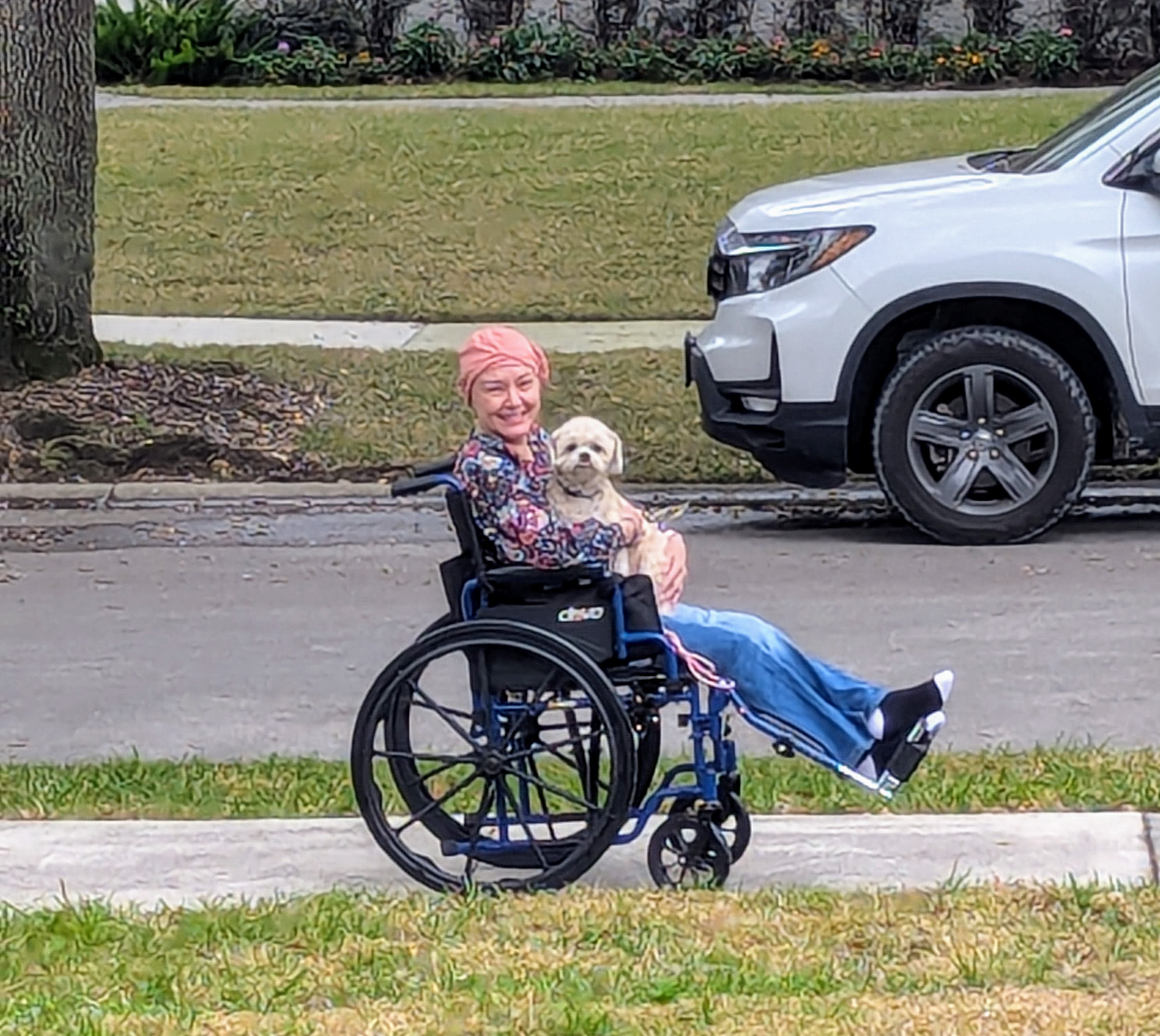
She can’t walk anymore. The electric wheelchair gives her about an hour and a half of mobility before the pain forces her to lie down. The cancer has spread to her bones. Yet, somehow, she still smiles. She still refuses to give up.
Breakfast has always been my favorite meal. Now its much more than that, its a check in with a smile still here.

The Power of Presence: How to Support Caregivers
When someone you love is gravely ill or bedridden, the world becomes very small. The walls of the home close in. Time slows. Days blur together. Both the person being cared for—and the caregiver—begin to live in a kind of suspended animation, where joy, spontaneity, and connection are replaced by routine, worry, and waiting.
People often ask, “What can I do?”
And it’s a sincere question. They want to help. So they send flowers. Cards. Food. Gift cards. And all of those are kind gestures. All of them are appreciated.
But if you really want to help a caregiver—and the person they’re caring for—be present. Show up.
Caregiving is not just physically exhausting. It’s emotionally isolating. The one who is ill is often trapped in their body, in their symptoms, in a bed they can’t escape. The caregiver, meanwhile, is trapped in responsibility, routine, and quiet desperation.
Isolation is the great thief.
It steals joy, perspective, and sometimes even hope. But when someone walks through the door just to be there, everything changes—even if only for a little while.
Here’s what you may not see:
When visitors come over, something shifts.
The house feels lighter.
The person being cared for suddenly wants to sit up straighter, to smile, to tell stories—even if they can’t move or speak much.
The caregiver may finally exhale, just a little.
You don’t need to bring anything. Just your presence. A shared moment. A hand held. A joke told. A prayer whispered.
It’s not about what you do. It’s about that you came.
We often overcomplicate compassion. We think we need the “right” thing, the perfect timing, or something polished and proper.
But love isn’t complicated.
Compassion shows up unannounced and says, “I’m here.”
It’s the ministry of presence.
So, if you’re wondering how to help:
- Visit. Even 15 minutes can be sacred.
- Sit. Watch a show, listen to music, share a memory.
- Talk. About something—anything—besides illness.
- Listen. Sometimes just being a witness to the struggle is a gift.
- Stay connected. Don’t let their world shrink without a fight.
Because at the end of the day, love looks like presence. And presence heals in ways medicine can’t.

Understanding Anticipatory Grief as a Caregiver
I’ve spent a lifetime wearing uniforms — first in the military, then in business — but no uniform could have prepared me for the one I wear now: caregiver.
My wife is still here. She still smiles. Still laughs. Still says “I love you” with the same strength that got her through childbirth without a scream and once drove a screwdriver bit through her hand with nothing more than a calm “ouch.” But even with all that strength, I know what’s coming. And somewhere along the way, I realized I was already grieving.
It wasn’t denial that kept me from seeing it; I saw every scan, every new medication, every tear. It wasn’t anger that overwhelmed me, though I’ve certainly felt flashes of frustration — at broken systems, unanswered prayers, and my own helplessness. It was something quieter. Slower. A gradual ache of knowing that the woman I love is slipping away in pieces.
That’s what anticipatory grief is — mourning someone while they’re still alive. It’s showing up with love and purpose even as the shadows grow longer. It’s grieving not just the final goodbye, but the thousands of little ones along the way: the goodbye to traveling together, to her independence, to her baking and cooking in the kitchen.
I’ve come to understand that the five stages of grief — denial, anger, bargaining, depression, acceptance — aren’t a straight road. They’re more like a roundabout we circle again and again. And while Kübler-Ross introduced them to describe how patients face terminal illness, caregivers like me feel them too — just in advance.
Right now, I live somewhere between acceptance and heartbreak. I’ve accepted what’s coming. But each day, I still fight to create joy, dignity, and presence. We watch movies in the car so she doesn’t have to get out. We eat takeout in the bed because she cant sit at the table. I hold her hand not just in sickness, but in the holy weight of being here — now.
If you’re walking this road too, know that grief doesn’t wait for death. And love doesn’t wait for perfection. You are doing holy work, even when your hands feel empty.
Let yourself grieve. But also — let yourself love, fiercely, while there’s still time.

The Art of Caregiving: Strategies for Support
“You have to go for a walk. Take a hot shower. Make sure you hit the rack every night early. I mean like 2000 hours at the latest. Every day is just like the military. You’re preparing for the next day.”
That’s what my buddy—another veteran who recently lost his wife to pancreatic cancer—told me. It stuck. Not because it was profound (although it is), but because it was familiar. It’s the kind of advice you’d hear before a deployment. Only now the mission is different. It’s longer. Harder in ways I never expected. And it’s personal.
My wife Sherri is currently watching a movie in our EV, having lunch with our fur babies. It’s a simple solution to a hard problem: it spares her the pain of getting out of the car, into the electric wheelchair, into the house—only to turn around and do it all again in 35 minutes. During that time, my sister-in-law (who’s been a godsend) and I tag-teamed lunch prep, charged the chair, rotated the laundry, and coaxed our teenager into eating something besides cereal. That’s the rhythm. That’s the operation.
It’s funny how much this mirrors the military. In downtime, you prep for the next mission. That’s what caregiving is: a constant cycle of readiness. Because when your loved one is in pain, even helping them move can feel like a landmine of unintended harm. You don’t get to wing it. You plan, prep, adapt, and repeat.
And here’s the kicker: you can’t pour from an empty canteen.
My friend reminded me—like a good NCO would—that I need rest. That I need to recoup. That doing “me time” isn’t selfish; it’s strategic. And yet it’s one of the hardest things to do. How do you step away when the person you love is hurting? But if you don’t, you break down. And when you’re broken, you’re no good to them.
For me, that “me time” is Orange Theory Fitness. It’s more than a workout—it’s my decompression chamber. The people there know my story. They don’t flinch when I show up in a weird mood or vent a little too hard. They get it. It’s a release valve.
But caregiving can’t be done alone. It requires an extended care circle, and let me tell you—building that after the crisis hits is like trying to patch the roof in a thunderstorm. As JFK said, “Fix the roof when the sun is shining.” He wasn’t wrong. Having my sister-in-law here has changed everything. And when she’s not, our neighborhood friends step up in ways that humble me. They’re part of the circle now. I’ve learned that asking for help doesn’t make you weak—it lets people love you in real, tangible ways.
There’s something beautiful about how people show up when you let them. It reaffirms your faith in humanity, even on the hardest days. And if you’re lucky—like I am—you see that caregiving, as hard as it is, is also a sacred kind of service. One where love, not rank, leads the charge.
So here’s what I’ll leave you with:
Build your circle when the skies are clear.
Rest like it’s your responsibility—because it is.
And never underestimate the power of kindness, sweat equity, and a hot shower.
Because when it’s raining, all of that matters more than you’ll ever know.
“Holding On: A Caregiver’s Reflection on Love, Loss, and Living in the Now”
My wife came home today.
After nearly a month that felt like a lifetime—through the emergency room, the operating room, recovery, and finally a rehabilitation hospital—she is back, sitting at the kitchen table with our daughter and her sister. They’re talking about summer camp. It sounds so normal. It looks so beautiful. And yet, nothing about this is normal.
She has four broken bones—fragile from cancer that has metastasized into her bones. She cries now, often. More than I’ve ever seen in all the years we’ve been together. Her voice is quiet. Barely audible sometimes. She has only her hands now to guide her through the world, needing an automated wheelchair that still hasn’t arrived because insurance bureaucracy doesn’t move at the speed of human need.
I was ready to buy one. But she said, “No. We’ll wait.” And so we do. Because this is her journey. And while everything in me wants to fix it—to make it easier, faster, better—I know what she needs most is for me to walk beside her, not ahead.
This is not my first time walking this path. I’ve been here before. With my sister. With my father. But knowing the route doesn’t make it easier. It just makes the heartbreak familiar.
Yet she continues to defy the odds. She is part of the 3% who’ve made it this far. A walking miracle. A living lesson in endurance. So we stay grateful. We stay hopeful. We keep our chins up—not just for her, but for ourselves and everyone around us.
Caregiving is the quiet battlefield. You fight fatigue, frustration, and the aching helplessness of watching someone you love suffer. You become nurse, advocate, counselor, and spiritual anchor—all while trying to remember who you are.
But caregiving also sharpens your vision. You begin to see what matters.
It’s the sound of her voice, barely above a whisper, joining in a conversation at the table.
It’s the laughter that somehow still finds its way into our home.
It’s the love that survives even the most brutal storms.
We often think of time as a currency, but when you’re a caregiver, you realize it’s far more precious than money. It is sacred. It is fleeting. It is everything.
So if you’re reading this in the middle of your own storm, hold on. Don’t just wait for the clouds to pass—find the grace in the moments in between. Because even in the darkest stretches, there is light. Sometimes it’s a whisper. Sometimes it’s a smile. Sometimes it’s just sitting quietly at the kitchen table with the ones you love.
Hold onto that.


