Blog Archives
The Art of Caregiving: Strategies for Support
“You have to go for a walk. Take a hot shower. Make sure you hit the rack every night early. I mean like 2000 hours at the latest. Every day is just like the military. You’re preparing for the next day.”
That’s what my buddy—another veteran who recently lost his wife to pancreatic cancer—told me. It stuck. Not because it was profound (although it is), but because it was familiar. It’s the kind of advice you’d hear before a deployment. Only now the mission is different. It’s longer. Harder in ways I never expected. And it’s personal.
My wife Sherri is currently watching a movie in our EV, having lunch with our fur babies. It’s a simple solution to a hard problem: it spares her the pain of getting out of the car, into the electric wheelchair, into the house—only to turn around and do it all again in 35 minutes. During that time, my sister-in-law (who’s been a godsend) and I tag-teamed lunch prep, charged the chair, rotated the laundry, and coaxed our teenager into eating something besides cereal. That’s the rhythm. That’s the operation.
It’s funny how much this mirrors the military. In downtime, you prep for the next mission. That’s what caregiving is: a constant cycle of readiness. Because when your loved one is in pain, even helping them move can feel like a landmine of unintended harm. You don’t get to wing it. You plan, prep, adapt, and repeat.
And here’s the kicker: you can’t pour from an empty canteen.
My friend reminded me—like a good NCO would—that I need rest. That I need to recoup. That doing “me time” isn’t selfish; it’s strategic. And yet it’s one of the hardest things to do. How do you step away when the person you love is hurting? But if you don’t, you break down. And when you’re broken, you’re no good to them.
For me, that “me time” is Orange Theory Fitness. It’s more than a workout—it’s my decompression chamber. The people there know my story. They don’t flinch when I show up in a weird mood or vent a little too hard. They get it. It’s a release valve.
But caregiving can’t be done alone. It requires an extended care circle, and let me tell you—building that after the crisis hits is like trying to patch the roof in a thunderstorm. As JFK said, “Fix the roof when the sun is shining.” He wasn’t wrong. Having my sister-in-law here has changed everything. And when she’s not, our neighborhood friends step up in ways that humble me. They’re part of the circle now. I’ve learned that asking for help doesn’t make you weak—it lets people love you in real, tangible ways.
There’s something beautiful about how people show up when you let them. It reaffirms your faith in humanity, even on the hardest days. And if you’re lucky—like I am—you see that caregiving, as hard as it is, is also a sacred kind of service. One where love, not rank, leads the charge.
So here’s what I’ll leave you with:
Build your circle when the skies are clear.
Rest like it’s your responsibility—because it is.
And never underestimate the power of kindness, sweat equity, and a hot shower.
Because when it’s raining, all of that matters more than you’ll ever know.
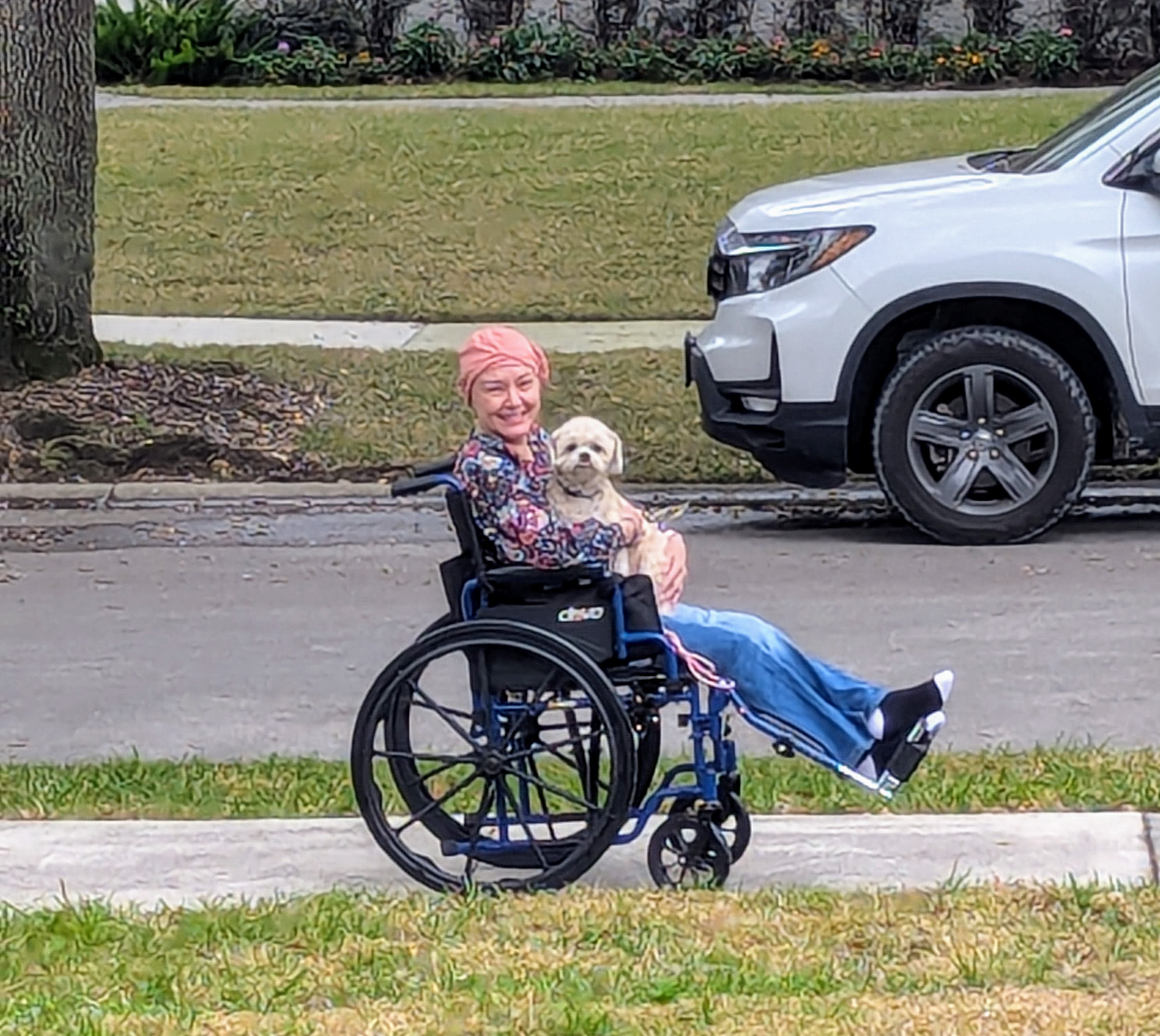
“Holding On: A Caregiver’s Reflection on Love, Loss, and Living in the Now”
My wife came home today.
After nearly a month that felt like a lifetime—through the emergency room, the operating room, recovery, and finally a rehabilitation hospital—she is back, sitting at the kitchen table with our daughter and her sister. They’re talking about summer camp. It sounds so normal. It looks so beautiful. And yet, nothing about this is normal.
She has four broken bones—fragile from cancer that has metastasized into her bones. She cries now, often. More than I’ve ever seen in all the years we’ve been together. Her voice is quiet. Barely audible sometimes. She has only her hands now to guide her through the world, needing an automated wheelchair that still hasn’t arrived because insurance bureaucracy doesn’t move at the speed of human need.
I was ready to buy one. But she said, “No. We’ll wait.” And so we do. Because this is her journey. And while everything in me wants to fix it—to make it easier, faster, better—I know what she needs most is for me to walk beside her, not ahead.
This is not my first time walking this path. I’ve been here before. With my sister. With my father. But knowing the route doesn’t make it easier. It just makes the heartbreak familiar.
Yet she continues to defy the odds. She is part of the 3% who’ve made it this far. A walking miracle. A living lesson in endurance. So we stay grateful. We stay hopeful. We keep our chins up—not just for her, but for ourselves and everyone around us.
Caregiving is the quiet battlefield. You fight fatigue, frustration, and the aching helplessness of watching someone you love suffer. You become nurse, advocate, counselor, and spiritual anchor—all while trying to remember who you are.
But caregiving also sharpens your vision. You begin to see what matters.
It’s the sound of her voice, barely above a whisper, joining in a conversation at the table.
It’s the laughter that somehow still finds its way into our home.
It’s the love that survives even the most brutal storms.
We often think of time as a currency, but when you’re a caregiver, you realize it’s far more precious than money. It is sacred. It is fleeting. It is everything.
So if you’re reading this in the middle of your own storm, hold on. Don’t just wait for the clouds to pass—find the grace in the moments in between. Because even in the darkest stretches, there is light. Sometimes it’s a whisper. Sometimes it’s a smile. Sometimes it’s just sitting quietly at the kitchen table with the ones you love.
Hold onto that.
The Joy of Collecting: Finding Meaning in Everyday Treasures
I’ve always collected things—medals, pennies, shark teeth, rocks, golf balls, even tire valve caps. Some of these were intentional, others accidental. But all of them, in their own way, represent little victories and moments of peace.
Just the other night, I went on a walk after dinner, a habit more about unwinding than fitness. I came back with five golf balls. Five. That might not seem like a lot to some people, but for someone who’s spent a lifetime collecting, five of anything in one outing is a haul. It got me thinking—not about golf balls, but about collecting, and more curiously, why I do it.
Let me start with this: I’ve begun using lost golf balls as my own personal economic indicator. A kind of SWAG (scientific wild-ass guess). I know it’s a stretch, but hear me out—if people are out playing golf in the middle of the week and losing $20 sleeves of balls without a second thought, then someone out there is doing alright. I’m no fan of trickle-down economics, but the existence of a well-funded slice of the population still swinging away gives me a small sense of hope that the world hasn’t completely unraveled. Still, that’s not why I walk. I walk to escape that kind of thinking.
This post isn’t about economics. It’s about collecting.
My father used to collect pennies he found on walks. Before that, as a boy, he collected stamps. I picked up the penny habit from him, and at one point, my collection was medals—military ones. Now? It’s golf balls, and teeth from long-dead sharks. And that’s the distinction I want to make. Stamps and medals feel like hobbies. You go out, you pay money, you build your collection. But to me, collecting has always been about the hunt—the unplanned, unscheduled discovery. The moment you spot something unexpected glinting in the grass or poking out from the sand. That’s collecting.
There’s real joy in that moment—when you pause, bend down, and confirm that yes, it’s a golf ball or a shark tooth or some little artifact the world left behind. It feels like you’ve won something. Like you’re seeing what others overlook. It might sound like a stretch, but in those moments I feel capable, even special.
Turns out, there’s science to back that up. Psychologists have long studied the drive to collect. Some say it’s tied to our ancestral instincts—early humans were gatherers, after all. Others say collecting brings order to chaos, structure to a fast-moving world. According to researchers, collecting can also provide a sense of control, personal identity, even legacy. But more than that, when we find something—especially something unexpected—our brain releases a hit of dopamine. The same reward chemical that fires when we eat good food, laugh, or fall in love. So yes, spotting a golf ball in the grass isn’t just coincidence—it’s chemically rewarding. No wonder I keep looking.
In those moments, I’m not thinking about work, or stress, or the headlines. I’m just walking. And collecting. And somehow, connecting to the people who came before me—my dad and his pennies, the long-lost owner of the golf ball, even the shark whose tooth found its way into my palm.
Collecting, for me, isn’t about things. It’s about finding meaning in the everyday. It’s about knowing that even in a world spinning out of control, there are still small, lost treasures waiting to be found.


Finding Strength in Fear: A Roadmap for Resilience
Sometimes we all need strength to persevere. Some days are harder than others. Some moments are like ice. Sometimes we need to have a plan to move forward. This is mine.
That feeling—of being stuck in place while time barrels forward like a freight train—is terrifying. The quiet becomes a roar. Your heart races while your body doesn’t move. It feels like you’re standing on a shore, watching a storm roll in, knowing you can’t hold back the waves.
But you’re not alone in this.
When fear takes over, survival doesn’t look like bravery. It looks like breathing, getting out of bed, putting one foot in front of the other, even if you don’t know where you’re going yet.
Here’s a small roadmap—just enough to get through one moment, then the next:
1. Name It
Say out loud (or write it down):
“I’m afraid of ____. I feel like ____.”
Giving fear a name takes away some of its power. It makes it something you are experiencing—not something that is you.
2. Shrink the Future
When the future feels unbearable, don’t try to live it all at once.
Try living just the next five minutes.
Then the next hour.
You’ll be surprised how far that can carry you.
3. Choose One Thing You Can Control
Maybe it’s taking a walk.
Making a cup of coffee.
Writing a message to someone you trust.
Control just one thing. That can be enough to anchor you today.
4. Let Others Be Your Strength
Even if you feel like a burden—you’re not.
Let someone carry a bit of this with you.
You don’t have to have the right words. Just say:
“I’m not okay. Can you just sit with me in this for a moment?”
5. Grace Over Guilt
If all you did today was survive—that counts.
You don’t have to fix everything. Not today. Maybe not even tomorrow.
You just have to keep showing up. You already are.
You asked how you can survive it.
You survive it the same way you’ve survived every hard thing before:
With a cracked heart and the quiet strength you don’t even realize you have.
And when you’re ready, we can talk about how to walk forward—not fast, just real.
I’m here for that walk whenever you are.


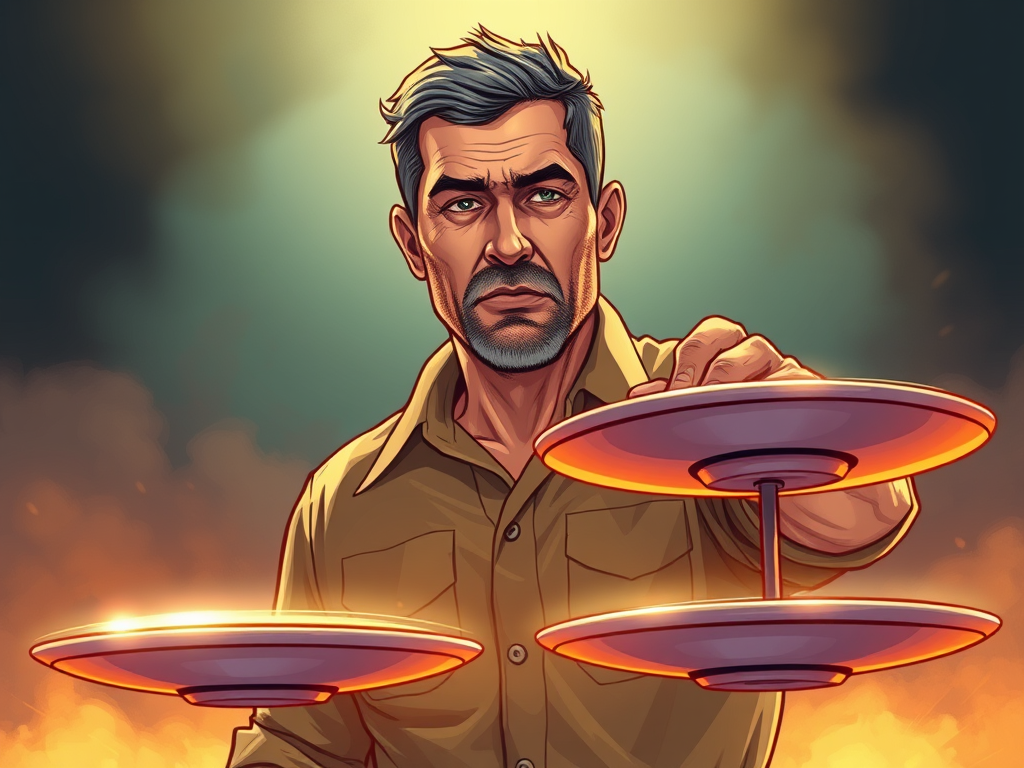
Spinning Plates: Finding Balance After Military Service
Transitioning from military service to the civilian workforce is like spinning plates on sticks—you’ve got to keep everything moving while figuring out which plates need the most attention. The challenge isn’t just about finding a job; it’s about finding balance—between personal values, professional expectations, and the reality of today’s job market.
The military made many of these decisions for us. Where to be, what to do, how to prioritize. It was all part of the mission. Now, those choices are ours to make—but that doesn’t mean it’s easy.
One of the biggest struggles I face? Knowing when to set boundaries without being labeled as “not a team player.”
💡 Is being available 24/7 just the nature of high-paying jobs?
💡 Does part-time still mean part-time, or is it now a full-time commitment for less pay?
💡 How can you stand up for yourself in a workplace that expects more but gives less?
A mentor once told me, “It’s not like juggling—it’s like keeping plates spinning.” You have to constantly adjust your time, focus, and energy. Some plates require more effort. Others? Not worth the extra spin.
I was used to structure, leadership, and mission-driven work. But out here? The mission is you. If you don’t set your priorities, someone else will do it for you.
🚨 Call to Action: 🚨
✔ Know your worth. Don’t let employers take advantage of your work ethic.
✔ Set boundaries. Being available 24/7 doesn’t me your superstar; it’s about effectiveness.
✔ Help others. Share your experiences. Let’s keep each other from spinning plates that don’t deserve our time.
What lessons have you learned about balancing career, family, and well-being after service? Drop your thoughts in the comments—let’s make this a conversation that helps veterans take control of their futures.
A full life
What are your thoughts on the concept of living a very long life?
So I believe life is not about time, but what a person does within it.
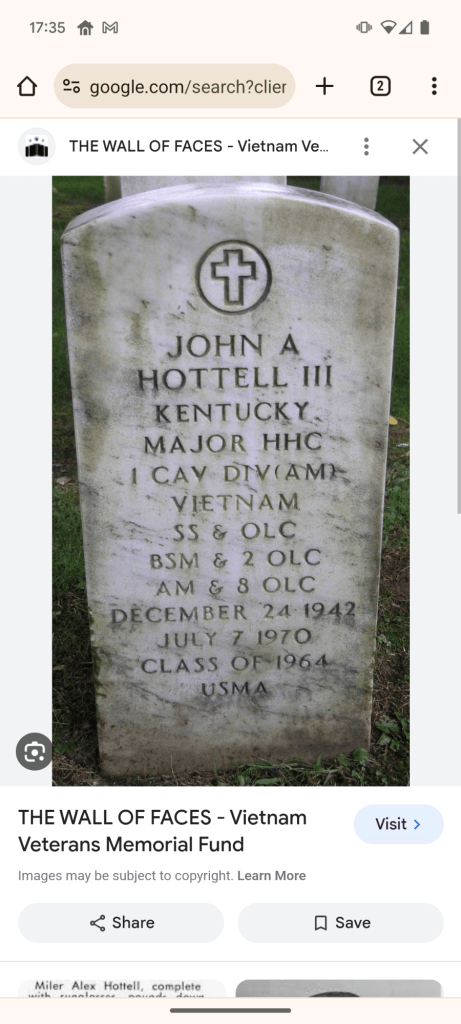
Not even 30 years old and this Gentleman whose marker is above had a very full life and most important was content with it. He wrote his obituary before going to Vietnam which is how I’m able to make such a statement.
I just learned of his amazing life while paying my respects to a cherished mentor of mine, who has but a few days left. My mentor wanted to share the story of MAJ Hottell on his death bed as it was his regret he wasn’t able to pay respects to him in his lifetime.
Hence, its very easy for me to say its not the minutes that count but the things within them.


