The Art of Caregiving: Strategies for Support
“You have to go for a walk. Take a hot shower. Make sure you hit the rack every night early. I mean like 2000 hours at the latest. Every day is just like the military. You’re preparing for the next day.”
That’s what my buddy—another veteran who recently lost his wife to pancreatic cancer—told me. It stuck. Not because it was profound (although it is), but because it was familiar. It’s the kind of advice you’d hear before a deployment. Only now the mission is different. It’s longer. Harder in ways I never expected. And it’s personal.
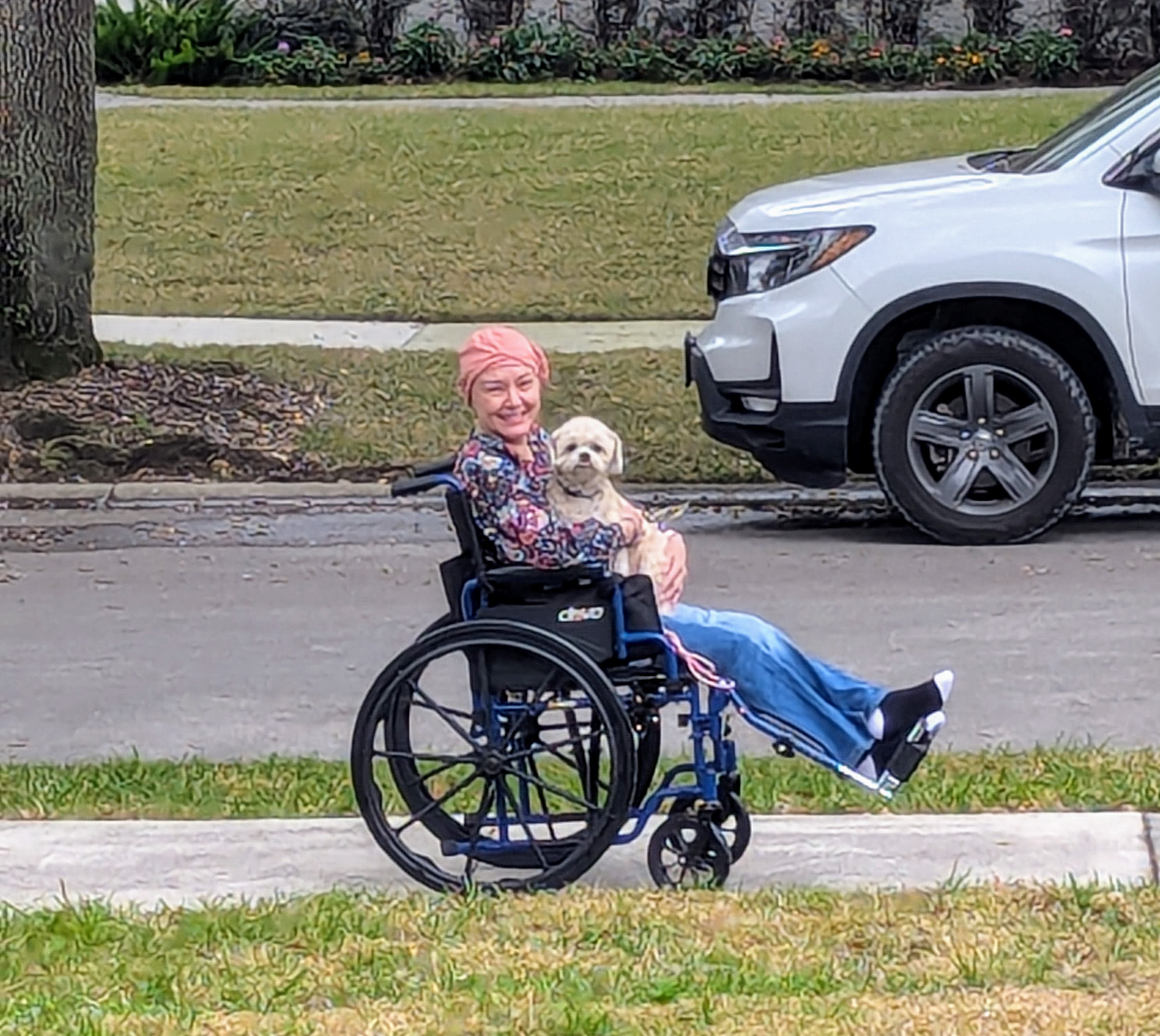
My wife Sherri is currently watching a movie in our EV, having lunch with our fur babies. It’s a simple solution to a hard problem: it spares her the pain of getting out of the car, into the electric wheelchair, into the house—only to turn around and do it all again in 35 minutes. During that time, my sister-in-law (who’s been a godsend) and I tag-teamed lunch prep, charged the chair, rotated the laundry, and coaxed our teenager into eating something besides cereal. That’s the rhythm. That’s the operation.
It’s funny how much this mirrors the military. In downtime, you prep for the next mission. That’s what caregiving is: a constant cycle of readiness. Because when your loved one is in pain, even helping them move can feel like a landmine of unintended harm. You don’t get to wing it. You plan, prep, adapt, and repeat.
And here’s the kicker: you can’t pour from an empty canteen.
My friend reminded me—like a good NCO would—that I need rest. That I need to recoup. That doing “me time” isn’t selfish; it’s strategic. And yet it’s one of the hardest things to do. How do you step away when the person you love is hurting? But if you don’t, you break down. And when you’re broken, you’re no good to them.
For me, that “me time” is Orange Theory Fitness. It’s more than a workout—it’s my decompression chamber. The people there know my story. They don’t flinch when I show up in a weird mood or vent a little too hard. They get it. It’s a release valve.
But caregiving can’t be done alone. It requires an extended care circle, and let me tell you—building that after the crisis hits is like trying to patch the roof in a thunderstorm. As JFK said, “Fix the roof when the sun is shining.” He wasn’t wrong. Having my sister-in-law here has changed everything. And when she’s not, our neighborhood friends step up in ways that humble me. They’re part of the circle now. I’ve learned that asking for help doesn’t make you weak—it lets people love you in real, tangible ways.
There’s something beautiful about how people show up when you let them. It reaffirms your faith in humanity, even on the hardest days. And if you’re lucky—like I am—you see that caregiving, as hard as it is, is also a sacred kind of service. One where love, not rank, leads the charge.
So here’s what I’ll leave you with:
Build your circle when the skies are clear.
Rest like it’s your responsibility—because it is.
And never underestimate the power of kindness, sweat equity, and a hot shower.
Because when it’s raining, all of that matters more than you’ll ever know.

Posted on June 11, 2025, in Caregving, and tagged #caregiving, #love, #resilence, #time, health, life, mental-health. Bookmark the permalink. Leave a comment.


Leave a comment
Comments 0